


Page 241 - The Book of Caterpillars: A Life-Size Guide to Six Hundred Species From Around the World
P. 241
BUTTERFLY CATERPILLARS

                      FAMILY  Nymphalidae
                  DISTRIBUTION  Madagascar, India, Southeast Asia, Chinese Taipei, southern
                           Japan, New Guinea, Australia, and islands of the South Paci c,

                           east to French Polynesia and Easter Island
                     HABITAT  Savannahs and open woodlands, particularly in tropical and
                           subtropical areas
                  HOST PLANTS  Wide range from at least nine families, but commonly joyweed
                           (Alternanthera spp.) and Common Asystasia (Asystasia gangetica)
                      NOTE  Caterpillar that is gregarious in the early instars
             CONSERVATION STATUS  Not evaluated, but common in tropical and subtropical areas


                                                                                   ADULT WINGSPAN
                                                                                  3–3⅜ in (76–86 mm)
                                                                                  CATERPILLAR LENGTH
                                                                                    2 ⁄   in (53 mm)
            HYPOLIMNAS BOLINA
            VARIED EGGFLY                                                                        239

            (LINNAEUS, 1758)


            Varied Egg y caterpillars hatch from eggs that are laid in batches
            on the underside of leaves of the food plant. The caterpillars
            feed gregariously when young but singly when mature. Feeding
            occurs at night, and caterpillars may hide some distance from
            their food plant during the day. In tropical areas, caterpillars can
            be found throughout the year, and the larval stage can last as little
            as three weeks. The pupa is attached to a silk pad and suspended
            by the cremaster on or near the food plant.


            Some populations of the Varied Egg y, also known as the Great
            Eggfly or Blue Moon, have been known to produce mainly

            female o spring because of the presence of Wolbachia bacteria,
            which kill male caterpillars in the egg. Although the species is
            not migratory, specimens are occasionally recorded well outside
            their normal breeding areas. The adult butter ies are found in

            moist gullies and urban gardens. The males are territorial and
            will guard a particular perch even after being disturbed by other

            intruding butter ies.

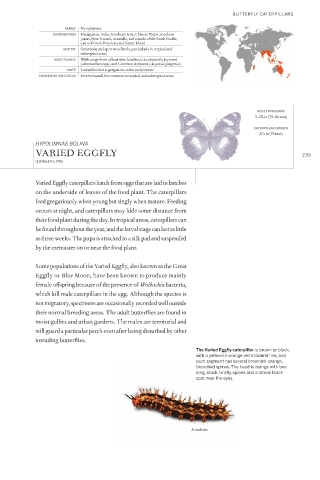
                                                                The Varied Egg y caterpillar is brown or black,
                                                                with a yellowish-orange ventrolateral line, and
                                                                each segment has several brownish-orange,
                                                                branched spines. The head is orange with two
                                                                long, black, bristly spines and a lateral black
                                                                spot near the eyes.


                                                              Actual size

