


Page 239 - The Book of Caterpillars: A Life-Size Guide to Six Hundred Species From Around the World
P. 239
BUTTERFLY CATERPILLARS

                      FAMILY  Nymphalidae
                  DISTRIBUTION  Mexico, south to the Amazon basin
                     HABITAT  Humid lowland rain forests and adjacent second growth
                  HOST PLANTS  Croton spp.
                      NOTE  Caterpillar that is widespread but rarely seen
             CONSERVATION STATUS  Not evaluated, but not likely to become endangered


                                                                                   ADULT WINGSPAN
                                                                                  3½–4 in (90–100 mm)
                                                                                  CATERPILLAR LENGTH
                                                                                  2⅜–2¾ in (60–70 mm)
            HYPNA CLYTEMNESTRA
            JAZZY LEAFWING                                                                       237

            (CRAMER, 1777)


            The oddly shaped caterpillar of the Jazzy Leafwing resembles
            a piece of dead leaf, a bird dropping, or some other inedible
            piece of forest detritus, making it unlikely to be found by hungry
            predators such as birds. While not feeding, larvae often rest near
            a damaged portion of the host plant to further enhance their
            crypsis. Early instars rest out on the ends of fragile frass chains,
            which they begin to build immediately after hatching. At later
            instars, too, the caterpillars are one of the few species of their
            tribe Anaenini that do not rest inside rolled-up host plant leaves.


            Jazzy Leafwings are among the largest members of Anaenini.
            The fast- ying adults, which feed predominantly on rotting

            fruit, are widely distributed but rarely encountered. The
            caterpillar’s host plants are in the genus Croton, among them
            C. lechleri, known in some areas of eastern Ecuador as Sangre de
            Drago, or Dragon’s Blood, for its thick, bloodred sap, which is
            harvested and used for myriad medicinal purposes, from treating
            minor cuts to curing ulcers.


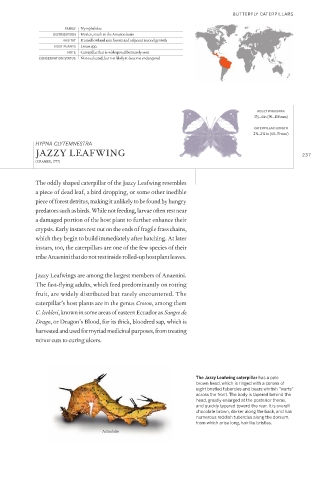
                                                                The Jazzy Leafwing caterpillar has a pale
                                                                brown head, which is ringed with a corona of
                                                                eight bristled tubercles and bears whitish “warts”
                                                                across the front. The body is tapered behind the
                                                                head, greatly enlarged at the posterior thorax,
                                                                and quickly tapered toward the rear. It is overall
                                                                chocolate brown, darker along the back, and has
                                                                numerous reddish tubercles along the dorsum,
                                                                from which arise long, hairlike bristles.
                                  Actual size

