


Page 265 - The Book of Caterpillars: A Life-Size Guide to Six Hundred Species From Around the World
P. 265
BUTTERFLY CATERPILLARS

                      FAMILY  Nymphalidae
                  DISTRIBUTION  The Andes of Colombia and Ecuador
                     HABITAT  Mid-elevation cloud forests, forest edges,
                           and bamboo-dominated gaps
                  HOST PLANTS  Bamboo (Chusquea spp.)


                      NOTE  Extremely cryptic caterpillar that is common but di cult to  nd
             CONSERVATION STATUS  Not evaluated, but unlikely to be endangered


                                                                                   ADULT WINGSPAN
                                                                                  1⅞–2⅛ in (48–54 mm)
                                                                                  CATERPILLAR LENGTH
                                                                                  1½–1⅝ in (38–42 mm)
            PEDALIODES PEUCESTAS
            PEDALIODES PEUCESTAS                                                                 263

            (HEWITSON, 1862)


            Eggs of Pedaliodes peucestas are laid singly, occasionally in
            pairs, on the underside of host plant leaves. The newly hatched
            caterpillar is tiny and pale white, with a bulbous, brown head.
            Its first meal is its own eggshell, but it quickly moves on to
            leaves, soon taking on the green coloration of its host plant and
            becoming nearly impossible to see. The cycle from egg-laying,

            through all  ve larval stages to the emergence of the adult can
            take more than 110 days. The pupal stage alone may last more
            than 25 days.
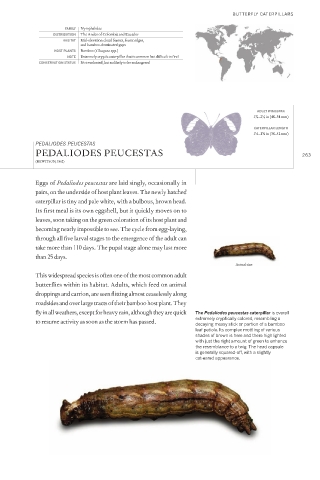
                                                                            Actual size
            This widespread species is often one of the most common adult
            butterflies within its habitat. Adults, which feed on animal

            droppings and carrion, are seen  itting almost ceaselessly along
            roadsides and over large tracts of their bamboo host plant. They

             y in all weathers, except for heavy rain, although they are quick   The Pedaliodes peucestas caterpillar is overall
            to resume activity as soon as the storm has passed.   extremely cryptically colored, resembling a
                                                               decaying mossy stick or portion of a bamboo
                                                               leaf petiole. Its complex mottling of various
                                                               shades of brown is here and there highlighted
                                                               with just the right amount of green to enhance
                                                               the resemblance to a twig. The head capsule
                                                               is generally squared-o  , with a slightly
                                                               cat-eared appearance.

