


Page 264 - The Book of Caterpillars: A Life-Size Guide to Six Hundred Species From Around the World
P. 264
BUTTERFLY CATERPILLARS

                                                     FAMILY  Nymphalidae
                                                 DISTRIBUTION
                                                 DISTRIBUTION
                                                 DIS TRIBUTION  Eastern Ecuador
                                                    HABITAT
                                                       A
                                                    HABIT
                                                    HABITAT T  Humid montane cloud forest understory and forest edges
                                                  HOST PLANTS
                                                  HOST PLANTS
                                                  HOS T PLANT S  Brugmansia aurea

                                                      NOTE
                                                       TE
                                                      NOTE  Caterpillar that snips o  leaves to eat at ground level
                                                      NO
                                             CONSERV A TION S T A TUS  Not evaluated, but not considered threatened
                                             CONSERVATION STATUS
                                             CONSERVATION STATUS
            ADULT WINGSPAN
           2⅛–2 ⁄   in (55–65 mm)
           CATERPILLAR LENGTH
           ¾–  ⁄   in (19–21 mm)
                                                                               OLERIA BAIZANA
                                                            BAEZA GLASSWING
    262
                                                                                   (HAENSCH, 1903)


                                            Baeza Glasswing caterpillars hatch from eggs laid singly, o  the
                                            host plant in the leaf litter. All instars are rather dull and similar in
                                            appearance to the mature caterpillar. They are slow moving and
                                            reluctant to react, even when touched, generally doing nothing
                                            more than curling into a tight ball. However, during the night,
                                            the larvae climb a food plant seedling and sever a leaf petiole,
                                            parachuting with the leaf to the ground, where they remain while

                                            feeding. There are  ve larval instars, and individuals take 75 to
                                            80 days to mature from oviposition to eclosion.
                      Actual size
                                            Larvae pupate under curled, dead leaves on the forest floor.
                                            The tiny, rounded pupa is a subtle, translucent, dark yellow

                                            with black markings, well camou aged in its leaf-litter habitat.
                                            The cycle recommences as the adults eclose and mate. Females
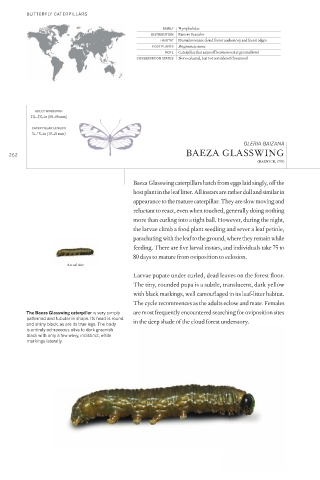
         The Baeza Glasswing caterpillar is very simply   are most frequently encountered searching for oviposition sites
         patterned and tubular in shape. Its head is round   in the deep shade of the cloud forest understory.
         and shiny black, as are its true legs. The body
         is entirely ochraceous olive to dark greenish
         black with only a few wavy, indistinct, white
         markings laterally.

