


Page 266 - The Book of Caterpillars: A Life-Size Guide to Six Hundred Species From Around the World
P. 266
BUTTERFLY CATERPILLARS

                                                     FAMILY  Nymphalidae
                                                 DISTRIBUTION
                                                 DISTRIBUTION
                                                 DIS TRIBUTION  The Andes of Venezuela, Colombia, Ecuador, and northern Peru
                                                       A
                                                    HABITAT
                                                    HABIT
                                                    HABITAT T  Mid-elevation cloud forests and forest edges
                                                    T PLANT
                                                  HOS
                                                  HOST PLANTS S  Paullinia spp.
                                                  HOST PLANTS
                                                      NO
                                                       TE
                                                      NOTE
                                                      NOTE  Rarely encountered caterpillar that has only recently been described
                                                     T
                                             CONSERVATION STATUS  Not evaluated, but not likely to be endangered
                                                      A
                                                  TION S
                                             CONSERVATION STATUS
                                             CONSERV
                                                      TUS
                                                 A
            ADULT WINGSPAN
           1¾–2 in (45–50 mm)
           CATERPILLAR LENGTH
            ¾–⅞ in (20–22 mm)
                                                                             PERISAMA OPPELII
                                                             CITRON PERISAMA
    264
                                                                                  (LATREILLE, [1809])
                                            Young Citron Perisama caterpillars rest on the skeletonized
                                            midveins of leaf tips that have been extended by a frass chain.
                                            Molting occurs near the tips of these safe havens. Later instars
                                            rest on the dorsal surface of leaves with their head tipped

                                            forward, scoli pressed  at, and body held either straight or in
                                            a slight S-curve. When disturbed, larvae thrash their head and

                                            abdomen, attempting to brush the o ending object away with
                                            the head scoli. They drop from the plant only reluctantly, and
                                            must be strongly provoked before thrashing.

                      Actual size
                                            The emerald-green pupa is attached by the cremaster to the
                                            dorsal surface of a leaf, and adults emerge about 20 days after
                                            pupation. Male Citron Perisama butterflies visit wet sand
                                            enriched with urine or feces, and they often feed on the sides
                                            of buildings or on dirty clothes, periodically curling their
                                            abdomen under their body and exuding a droplet of liquid that

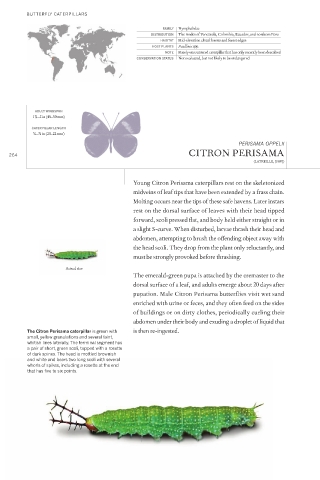
          The Citron Perisama caterpillar is green with   is then re-ingested.
          small, yellow granulations and several faint,
          whitish lines laterally. The terminal segment has
          a pair of short, green scoli, topped with a rosette
          of dark spines. The head is mottled brownish
          and white and bears two long scoli with several
          whorls of spikes, including a rosette at the end
          that has   ve to six points.

