


Page 263 - The Book of Caterpillars: A Life-Size Guide to Six Hundred Species From Around the World
P. 263
BUTTERFLY CATERPILLARS

                      FAMILY  Nymphalidae
                    TRIBUTION
                  DISTRIBUTION  North America, from Alaska to Quebec and south to Wisconsin
                  DIS
                  DISTRIBUTION
                     HABIT
                        A
                     HABITAT T  Mid-elevation pine forests and grasslands
                     HABITAT
                  HOST PLANTS S  Various sedges and grasses, including Carex spp. and Festuca spp.
                    T PLANT
                  HOS
                  HOST PLANTS
                      NOTE
                        TE
                      NOTE  Caterpillar that may be vulnerable in a warming climate
                      NO
                  A
                      T
                       TUS
                   TION S
                       A
             CONSERV
             CONSERVATION STATUS  Not evaluated, but considered secure in most of its range
             CONSERVATION STATUS
                                                                                   ADULT WINGSPAN
                                                                                  1¾–2⅛ in (45–54 mm)
                                                                                  CATERPILLAR LENGTH
                                                                                    1⅜ in (35 mm)
            OENEIS CHRYXUS
            CHRYXUS ARCTIC                                                                       261
            (DOUBLEDAY, [1849])
            Chryxus Arctic caterpillars are biennial, overwintering twice,
            and have five instars. The female finds sedges growing in a
            turf-like mat under a pine tree and lays an egg on a dead branch
            just above the sedge. The tiny caterpillar then drops onto the
            sedge, feeds for several months, and overwinters. It feeds during
            the next brief summer and then overwinters once more as a
            nearly mature caterpillar. The following spring, after feeding
            briefly, it turns into a brown-orange pupa in a slight silken
            cocoon in the litter, emerging as an adult in June.


            Adults suck the nectar from a number of  ower species but also
            sip moisture from wet soil. Several dozen Oeneis species occur
            in high latitude areas in North America and Eurasia. All have
            similar caterpillars, but most live on grassland or tundra. As the
            species are well adapted to living in harsh environments, global
            warming could reduce numbers.


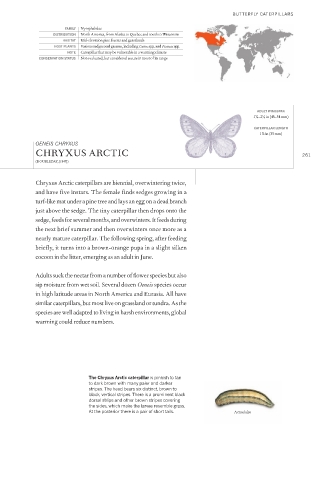
                             The Chryxus Arctic caterpillar is pinkish to tan
                             to dark brown with many paler and darker
                             stripes. The head bears six distinct, brown to
                             black, vertical stripes. There is a prominent black
                             dorsal stripe and other brown stripes covering
                             the sides, which make the larvae resemble grass.
                             At the posterior there is a pair of short tails.  Actual size

