


Page 302 - The Book of Caterpillars: A Life-Size Guide to Six Hundred Species From Around the World
P. 302
MOTH CATERPILLARS

                                                     FAMILY  Limacodidae
                                                 DISTRIBUTION  Nepal, northeast India, Myanmar, southern China, Thailand,
                                                          Laos, Vietnam, Borneo, Chinese Taipei, and southern Japan
                                                    HABITAT  Lowland and montane tropical and subtropical forests
                                                  HOST PLANTS  Many, including Rock Oak (Lithocarpus konishii),
                                                          lychee (Litchi spp.), and Liquidambar spp.
                                                      NOTE  Caterpillar that has a geometric, tentlike shape
                                             CONSERVATION STATUS  Not evaluated, but common


            ADULT WINGSPAN
             1 in (25 mm)
           CATERPILLAR LENGTH
             ⅜ in (10 mm)                                          DEMONAROSA RUFOTESSELLATA
                                                                    DEMONAROSA
                                                              RUFOTESSELLATA
    300
                                                                                    (MOORE, 1879)


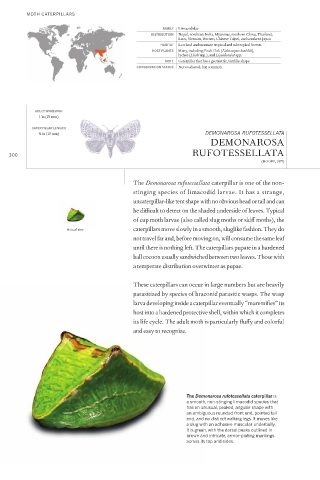
                                            The Demonarosa rufotessellata caterpillar is one of the non-
                                            stinging species of limacodid larvae. It has a strange,
                                            uncaterpillar-like tent shape with no obvious head or tail and can


                                            be di cult to detect on the shaded underside of leaves. Typical

                                            of cup moth larvae (also called slug moths or ski  moths), the
                      Actual size           caterpillars move slowly in a smooth, sluglike fashion. They do
                                            not travel far and, before moving on, will consume the same leaf
                                            until there is nothing left. The caterpillars pupate in a hardened
                                            ball cocoon usually sandwiched between two leaves. Those with
                                            a temperate distribution overwinter as pupae.


                                            These caterpillars can occur in large numbers but are heavily
                                            parasitized by species of braconid parasitic wasps. The wasp

                                            larva developing inside a caterpillar eventually “mummi es” its
                                            host into a hardened protective shell, within which it completes

                                            its life cycle. The adult moth is particularly  u y and colorful

                                            and easy to recognize.


                                                             The Demonarosa rufotessellata caterpillar is
                                                             a smooth, non-stinging limacodid species that
                                                             has an unusual, peaked, angular shape with
                                                             an ambiguous rounded front end, pointed tail
                                                             end, and no distinct walking legs. It moves like
                                                             a slug with an adhesive muscular underbelly.
                                                             It is green, with the dorsal peaks outlined in
                                                             brown and intricate, armor-plating markings
                                                             across its top and sides.

