


Page 303 - The Book of Caterpillars: A Life-Size Guide to Six Hundred Species From Around the World
P. 303
MOTH CATERPILLARS

                      FAMILY  Limacodidae
                  DISTRIBUTION  Eastern United States, from Maine to Florida, and west to
                           Texas and Missouri
                     HABITAT  Woodlands, parks, and gardens
                  HOST PLANTS  Woody trees, such as oak (Quercus spp.), ash (Fraxinus spp.),
                           apple (Malus spp.), beech (Fagus spp.), and cherry (Prunus spp.)
                      NOTE  Covert, stinging caterpillar that is rarely seen
             CONSERVATION STATUS  Not evaluated, but not considered threatened


                                                                                   ADULT WINGSPAN
                                                                                  ¾–1¼ in (19–31 mm)
                                                                                  CATERPILLAR LENGTH
                                                                                    ¾ in (20 mm)
            EUCLEA DELPHINII
            SPINY OAK-SLUG                                                                       301

            (BOISDUVAL, 1832)


            Spiny Oak-slug caterpillars hatch from single eggs or small
            clusters, laid on the underside of leaves. Like most slug
            caterpillars, they prefer to feed and rest beneath older leaves,
            usually around the leaf edges. During the heat of the day, they
            can sometimes be found hiding between two leaves. The larvae
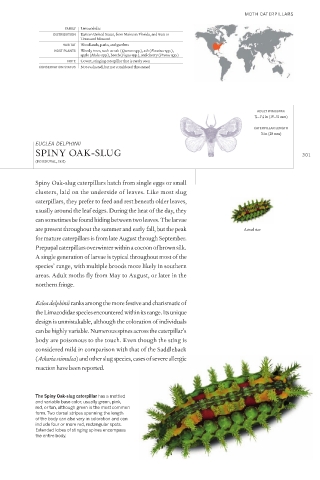
            are present throughout the summer and early fall, but the peak     Actual size
            for mature caterpillars is from late August through September.
            Prepupal caterpillars overwinter within a cocoon of brown silk.
            A single generation of larvae is typical throughout most of the
            species’ range, with multiple broods more likely in southern
            areas. Adult moths fly from May to August, or later in the
            northern fringe.


            Eclea delphinii ranks among the more festive and charismatic of
            the Limacodidae species encountered within its range. Its unique
            design is unmistakable, although the coloration of individuals
            can be highly variable. Numerous spines across the caterpillar’s
            body are poisonous to the touch. Even though the sting is
            considered mild in comparison with that of the Saddleback
            (Acharia stimulea) and other slug species, cases of severe allergic
            reaction have been reported.


            The Spiny Oak-slug caterpillar has a mottled
            and variable base color, usually green, pink,
            red, or tan, although green is the most common
            form. Two dorsal stripes spanning the length
            of the body can also vary in coloration and can
            include four or more red, rectangular spots.
            Extended lobes of stinging spines encompass
            the entire body.

