


Page 305 - The Book of Caterpillars: A Life-Size Guide to Six Hundred Species From Around the World
P. 305
MOTH CATERPILLARS

                      FAMILY  Limacodidae
                  DISTRIBUTION  Eastern United States, from New York State west to Texas,
                           and one area in Florida

                     HABITAT  Woodlands, parks, and  eld and roadside edges
                  HOST PLANTS  Swamp Oak (Quercus bicolor) and other Quercus spp.
                      NOTE  Well-defended caterpillar typically found on the underside
                           of leaves
             CONSERVATION STATUS  Not evaluated, and uncommon


                                                                                   ADULT WINGSPAN
                                                                                  ¾–
⁄   in (19–24mm)
                                                                                  CATERPILLAR LENGTH
            ISOCHAETES BEUTENMUELLERI                                             ⅜– ⁄   in (10–15 mm)
            BEUTENMUELLER’S
            SLUG MOTH                                                                            303

            (HY. EDWARDS, 1889)


            The Beutenmueller’s Slug Moth caterpillar is covert and solitary
            in nature, seldom seen, and an uncommon species throughout
            most of its normal range. The tiny larva is nearly transparent
            and sports multiple appendages armed with glass-like “hairs.”
            Physical contact with the caterpillar should be avoided, as it can
            cause dermatitis and other skin irritations. During later instars,
            these poisonous filaments encompass the caterpillar’s entire
            body, hence its more common name, Spun Glass Slug.


            During the eighth ( nal) instar, the larva sheds its formidable
            weaponry prior to metamorphosis within a brown, silken
            cocoon. A circular hatch at one end of the cocoon allows the
            transformed moth to exit. Adults—the females larger than
            the males— y from June through August. Like all Limacodidae

            caterpillar species, these crystalline creatures glide across the
            leaf with a sluglike motion, leaving a shiny trail wherever they
            go. They are active at night and dormant throughout most of
            the daylight hours.


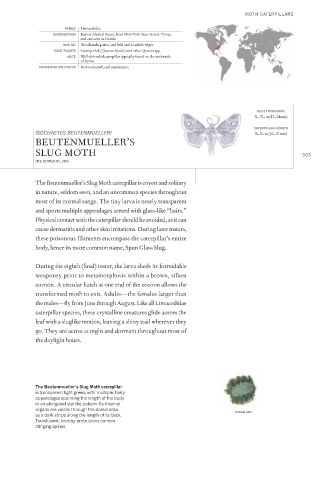
            The Beutenmueller’s Slug Moth caterpillar
            is transparent light green, with multiple, hairy
            appendages spanning the length of the body
            in an elongated starlike pattern. Its internal
            organs are visible through the dorsal area                      Actual size
            as a dark stripe along the length of its back.
            Translucent, knobby protrusions contain
            stinging spines.

