


Page 306 - The Book of Caterpillars: A Life-Size Guide to Six Hundred Species From Around the World
P. 306
MOTH CATERPILLARS

                                                     FAMILY  Limacodidae
                                                 DISTRIBUTION  Eastern United States, from Missouri to the Atlantic coast
                                                    HABITAT  Forests
                                                  HOST PLANTS  Beech (Fagus spp.), hickory (Carya spp.), oak (Quercus spp.),
                                                          chestnut (Castanea spp.), and hornbeam (Carpinus spp.)
                                                      NOTE  Caterpillar with a sting that can cause mild skin irritation
                                             CONSERVATION STATUS  Not evaluated, but common


            ADULT WINGSPAN
           ⅝–1⅛ in (16–29 mm)
           CATERPILLAR LENGTH
           ¾–1 ⁄   in (20–30 mm)
                                                                               NATADA NASONI
                                                         NASON’S SLUG MOTH
    304
                                                                                     (GROTE, 1876)


                                            The Nason’s Slug Moth caterpillar hatches from an egg laid
                                            individually on the host plant and is initially non-feeding,
                                            molting into its second instar without growth. Larger larvae
                                            are probably well defended from vertebrate predators by their
                                            toxins. In humans, inadvertent contact with the caterpillar causes
                      Actual size
                                            a sting, which, while of relatively low intensity, causes pain and
                                            can produce a rash, or blistering. Their toxins, however, do not
                                            make the larvae immune to attacks by parasitoids, such as the
                                            braconid Triraphis discoideus. In the late stages of development,
                                            the caterpillar makes a dense cocoon inside which it diapauses
                                            until spring, when it pupates. Adults  y in midsummer.


                                            Slug caterpillars, including those of the Nason’s Slug Moth, have
                                            unusual locomotion in which their highly elastic underbelly

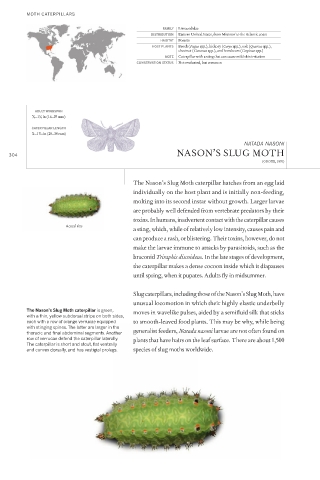
          The Nason’s Slug Moth caterpillar is green,   moves in wavelike pulses, aided by a semi uid silk that sticks
          with a thin, yellow subdorsal stripe on both sides,
          each with a row of orange verrucae equipped   to smooth-leaved food plants. This may be why, while being
          with stinging spines. The latter are larger in the
          thoracic and   nal abdominal segments. Another   generalist feeders, Natada nasoni larvae are not often found on
          row of verrucae defend the caterpillar laterally.   plants that have hairs on the leaf surface. There are about 1,500
          The caterpillar is short and stout,   at ventrally
          and convex dorsally, and has vestigial prolegs.  species of slug moths worldwide.

