


Page 307 - The Book of Caterpillars: A Life-Size Guide to Six Hundred Species From Around the World
P. 307
MOTH CATERPILLARS

                      FAMILY  Limacodidae
                  DISTRIBUTION  United States, from southern New England to Florida,
                           west to Texas
                     HABITAT  Barrens and woodland edges
                  HOST PLANTS  Woody trees, including oak (Quercus spp.), apple (Malus spp.),
                           and elm (Ulmus spp.)
                      NOTE  Leaf-feeding slug caterpillar
             CONSERVATION STATUS  Not evaluated, but common


                                                                                   ADULT WINGSPAN
                                                                                    ⁄  –1 ⁄   in (18–27 mm)
                                                                                  CATERPILLAR LENGTH
                                                                                    ¾ in (20 mm)
            PARASA CHLORIS
            SMALLER PARASA                                                                       305

            (HERRICH-SCHÄFFER, [1854])


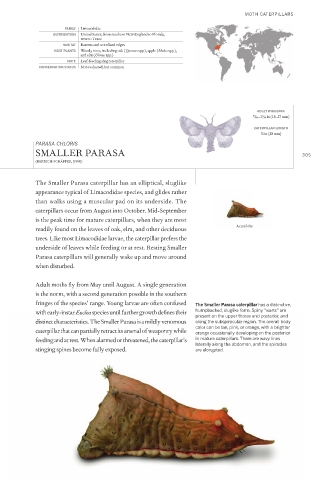
            The Smaller Parasa caterpillar has an elliptical, sluglike
            appearance typical of Limacodidae species, and glides rather
            than walks using a muscular pad on its underside. The
            caterpillars occur from August into October. Mid-September
            is the peak time for mature caterpillars, when they are most
            readily found on the leaves of oak, elm, and other deciduous    Actual size
            trees. Like most Limacodidae larvae, the caterpillar prefers the
            underside of leaves while feeding or at rest. Resting Smaller
            Parasa caterpillars will generally wake up and move around
            when disturbed.


            Adult moths  y from May until August. A single generation
            is the norm, with a second generation possible in the southern
            fringes of the species’ range. Young larvae are often confused   The Smaller Parasa caterpillar has a distinctive,

            with early-instar Euclea species until further growth de nes their   humpbacked, sluglike form. Spiny “warts” are
                                                               present on the upper thorax and posterior, and
            distinct characteristics. The Smaller Parasa is a mildly venomous   along the subspiracular region. The overall body
            caterpillar that can partially retract its arsenal of weaponry while   color can be tan, pink, or orange, with a brighter
                                                               orange occasionally developing on the posterior
            feeding and at rest. When alarmed or threatened, the caterpillar’s   in mature caterpillars. There are wavy lines
            stinging spines become fully exposed.              laterally along the abdomen, and the spiracles
                                                               are elongated.

