


Page 308 - The Book of Caterpillars: A Life-Size Guide to Six Hundred Species From Around the World
P. 308
MOTH CATERPILLARS

                                                     FAMILY  Limacodidae
                                                 DISTRIBUTION  Eastern Siberia, Japan, Korea, eastern China, and Chinese Taipei
                                                    HABITAT  Forests, agricultural land, parks, and gardens
                                                  HOST PLANTS  Many, including willow (Salix spp.), poplar (Populus spp.),
                                                          chestnut (Castanea spp.), persimmon (Diospyros spp.),
                                                          Citrus spp., and many other fruit trees
                                                      NOTE  Caterpillar that spends almost a year in the prepupal stage
                                             CONSERVATION STATUS  Not evaluated, but extremely common


            ADULT WINGSPAN
           1⅜–1 ⁄   in (35–40 mm)


           CATERPILLAR LENGTH
           1–1⅛ in (25–28 mm)
                                                                             PARASA CONSOCIA
                                                            PARASA CONSOCIA
    306
                                                                                     WALKER, 1865


                                            Parasa consocia caterpillars hatch from up to 150 eggs laid
                                            in small batches over a seven-day period. For the  rst couple

                                            of instars, the larvae are gregarious, grazing only the surface of
                                            leaves. They then disperse for the remainder of the eight or nine
                                            instars (totaling 27 to 37 days), devouring the entire leaf. Food
                      Actual size

                                            consumption in the  nal instar constitutes 80 percent of the total.
                                            The caterpillars overwinter inside a dark brown, oval cocoon,
                                            wedged into tree bark or in the soil, often in aggregations, for

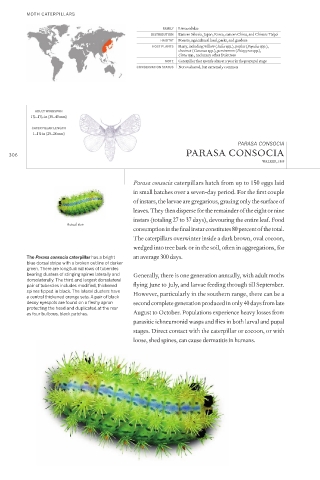
          The Parasa consocia caterpillar has a bright   an average 300 days.
          blue dorsal stripe with a broken outline of darker
          green. There are longitudinal rows of tubercles
          bearing clusters of stinging spines laterally and   Generally, there is one generation annually, with adult moths
          dorsolaterally. The third and largest dorsolateral

          pair of tubercles includes modi  ed, thickened    ying June to July, and larvae feeding through till September.
          spines tipped in black. The lateral clusters have   However, particularly in the southern range, there can be a
          a central thickened orange seta. A pair of black
          decoy eyespots are found on a   eshy apron   second complete generation produced in only 40 days from late
          protecting the head and duplicated at the rear
          as four bulbous, black patches.   August to October. Populations experience heavy losses from
                                            parasitic ichneumonid wasps and  ies in both larval and pupal

                                            stages. Direct contact with the caterpillar or cocoon, or with
                                            loose, shed spines, can cause dermatitis in humans.

