


Page 310 - The Book of Caterpillars: A Life-Size Guide to Six Hundred Species From Around the World
P. 310
MOTH CATERPILLARS

                                                     FAMILY  Limacodidae
                                                 DISTRIBUTION  Eastern North America, from southeastern Canada to Florida,
                                                          west to Texas
                                                    HABITAT  Forests
                                                  HOST PLANTS  Deciduous trees and shrubs, including apple (Malus spp.),
                                                          ash (Fraxinus spp.), cherry (Prunus spp.), dogwood (Cornus spp.),
                                                          oak (Quercus spp.), and willow (Salix spp.)
                                                      NOTE  Unusually shaped caterpillar with projections that bear
                                                          stinging hairs
                                             CONSERVATION STATUS  Not evaluated, but common


            ADULT WINGSPAN
             1 ⁄   in (30 mm)
           CATERPILLAR LENGTH
             1 in (25 mm)
                                                                         PHOBETRON PITHECIUM
                                                                    MONKEY SLUG
    308
                                                                              (J. E. SMITH & ABBOT, 1797)


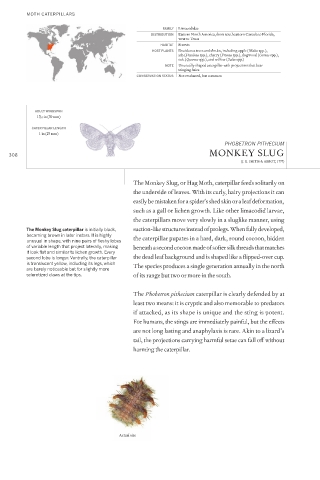
                                            The Monkey Slug, or Hag Moth, caterpillar feeds solitarily on
                                            the underside of leaves. With its curly, hairy projections it can
                                            easily be mistaken for a spider’s shed skin or a leaf deformation,
                                            such as a gall or lichen growth. Like other limacodid larvae,
                                            the caterpillars move very slowly in a sluglike manner, using
         The Monkey Slug caterpillar is initially black,   suction-like structures instead of prolegs. When fully developed,
         becoming brown in later instars. It is highly   the caterpillar pupates in a hard, dark, round cocoon, hidden
         unusual in shape, with nine pairs of   eshy lobes
         of variable length that project laterally, making   beneath a second cocoon made of softer silk threads that matches
         it look   at and similar to lichen growth. Every

         second lobe is longer. Ventrally, the caterpillar   the dead leaf background and is shaped like a  ipped-over cup.
         is translucent yellow, including its legs, which   The species produces a single generation annually in the north
         are barely noticeable but for slightly more
         sclerotized claws at the tips.     of its range but two or more in the south.

                                            The Phobetron pithecium caterpillar is clearly defended by at
                                            least two means: it is cryptic and also memorable to predators
                                            if attacked, as its shape is unique and the sting is potent.

                                            For humans, the stings are immediately painful, but the e ects
                                            are not long lasting and anaphylaxis is rare. Akin to a lizard’s

                                            tail, the projections carrying harmful setae can fall o  without
                                            harming the caterpillar.


                                       Actual size

