


Page 309 - The Book of Caterpillars: A Life-Size Guide to Six Hundred Species From Around the World
P. 309
MOTH CATERPILLARS

                      FAMILY  Limacodidae
                  DISTRIBUTION  Oriental tropics, from western India southeast to Borneo,
                           east to Chinese Taipei
                     HABITAT  Low to medium altitude forests
                  HOST PLANTS  Many, including banana (Musa spp.), Wood-oil Tree (Aleurites
                           cordata), Green Tea (Camellia sinensis), Teak (Tectona grandis),
                           and Chinese Tallow (Triadica sebifera)
                      NOTE  “Stinging nettle” slug caterpillar that has a lavender streak
             CONSERVATION STATUS  Not evaluated, but common


                                                                                   ADULT WINGSPAN

                                                                                  1⅜–1⅝ in (35–42 mm)

                                                                                  CATERPILLAR LENGTH
                                                                                    1 in (25 mm)
            PARASA PASTORALIS
            PARASA PASTORALIS                                                                    307

            BUTLER, 1885


            Like other cup moth (or slug moth) caterpillars, Parasa pastoralis
            larvae characteristically move in a fluid, sluglike, peristaltic
            fashion, as they do not have the de ned prolegs seen in most

            other caterpillars. Instead, they rely on an adhesive, muscular
            underbelly. Although they are polyphagous, their mode of
            locomotion restricts their choice of host plants to those with   Actual size
            smooth-surfaced foliage. As early instars, caterpillars graze
            only from the outer layer of the leaf but progress to full-leaf
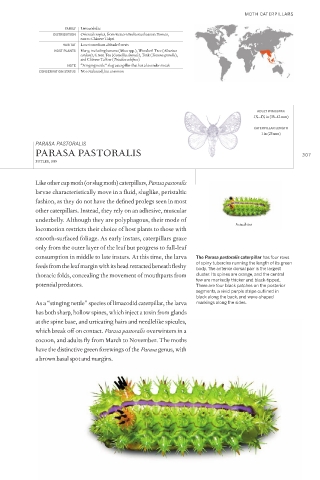
            consumption in middle to late instars. At this time, the larva   The Parasa pastoralis caterpillar has four rows

            feeds from the leaf margin with its head retracted beneath  eshy   of spiny tubercles running the length of its green
                                                                body. The anterior dorsal pair is the largest
            thoracic folds, concealing the movement of mouthparts from   cluster. Its spines are orange, and the central
            potential predators.                                few are markedly thicker and black-tipped.
                                                                There are four black patches on the posterior
                                                                segments, a vivid purple stripe outlined in
                                                                black along the back, and wave-shaped
            As a “stinging nettle” species of limacodid caterpillar, the larva   markings along the sides.
            has both sharp, hollow spines, which inject a toxin from glands
            at the spine base, and urticating hairs and needlelike spicules,
            which break o  on contact. Parasa pastoralis overwinters in a

            cocoon, and adults  y from March to November. The moths

            have the distinctive green forewings of the Parasa genus, with
            a brown basal spot and margins.

