


Page 312 - The Book of Caterpillars: A Life-Size Guide to Six Hundred Species From Around the World
P. 312
MOTH CATERPILLARS

                                                     FAMILY  Limacodidae
                                                 DISTRIBUTION  Southern China, Chinese Taipei, Thailand, and Indochina
                                                 DISTRIBUTION
                                                 DIS
                                                   TRIBUTION
                                                    HABIT
                                                    HABITAT
                                                    HABITAT T  Forests
                                                       A
                                                  HOST PLANTS
                                                  HOST PLANTS S  Polyphagous, including nutmeg (Myristica spp.)
                                                  HOS
                                                    T PLANT
                                                       TE
                                                      NO
                                                      NOTE
                                                      NOTE  Caterpillar that is sluglike and festooned with stinging spines
                                                     T
                                                 A
                                             CONSERVATION STATUS  Not evaluated, but common
                                                      A
                                                      TUS
                                                  TION S
                                             CONSERV
                                             CONSERVATION STATUS
            ADULT WINGSPAN


           1–1⅜ in (25–35 mm)
           CATERPILLAR LENGTH
             1⅜ in (35 mm)


                                                                              SUSICA SINENSIS
                                                                 SUSICA SINENSIS
    310
                                                                                    (WALKER, 1856)
                                            Susica sinensis caterpillars, like many other lepidopteran
                                            larvae, consume their freshly shed skins after molting from
                                            one instar to the next. Cup moth (or slug moth) caterpillars of
                                            the stinging variety, including S. sinensis, typically consume
                                            everything, spines and all. This species undergoes a dramatic
                                            transformation in terms of size, morphology, and color when

                                            it molts into the  nal instar. At earlier stages, the larvae display
                                            vivid blue markings on a green body, with the anterior and
                                            posterior dorsolateral scoli much longer than those in between.
                                            At maturity, the body is glossy white with green markings and
                                            all spiny scoli of uniform size.


                                            The stinging spines of limacodid slug caterpillars, including
                                            those of Susica sinensis, are capable of causing painful injuries if
                      Actual size
                                            in contact with human skin, introducing toxins produced from
                                            glands at the base of the hollow spines. This species is sometimes
                                            informally referred to as the Statuesque Cup Moth for its erect
                                            cartoon character-like postures, often while inverted.


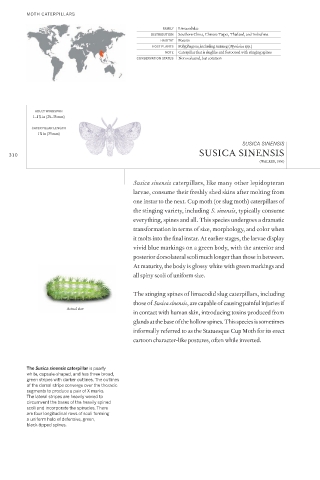
          The Susica sinensis caterpillar is pearly
          white, capsule-shaped, and has three broad,
          green stripes with darker outlines. The outlines
          of the dorsal stripe converge over the thoracic
          segments to produce a pair of X marks.
          The lateral stripes are heavily waved to
          circumvent the bases of the heavily spined
          scoli and incorporate the spiracles. There
          are four longitudinal rows of scoli forming
          a uniform halo of defensive, green,
          black-tipped spines.

