


Page 313 - The Book of Caterpillars: A Life-Size Guide to Six Hundred Species From Around the World
P. 313
MOTH CATERPILLARS

                      FAMILY  Limacodidae
                  DISTRIBUTION  United States, from New England south to Mississippi,
                           west to Missouri

                     HABITAT  Forests, woodlands, and  eld edges
                  HOST PLANTS  Oak (Quercus spp.), beech (Fagus spp.), willow (Salix spp.),
                           and other deciduous trees
                      NOTE  Slug caterpillar often mistakenly dismissed as a leaf abnormality
             CONSERVATION STATUS  Not evaluated


                                                                                   ADULT WINGSPAN
                                                                                   ⁄  –1  ⁄   in (15–43 mm)
                                                                                  CATERPILLAR LENGTH
                                                                                    ⅜ in (10 mm)
            TORTRICIDIA PALLIDA
            RED-CROSSED BUTTON SLUG                                                              311

            (HERRICH-SCHAFFER, 1854)


            The Red-crossed Button Slug and other button slug caterpillars
            appear to the naked eye as colorful oval (or round) “buttons”
            on the undersides of leaves, usually near the leaf edges. Solitary
            in nature, they are rarely observed occupying the same leaf
            as other caterpillars. While some have been seen “rocking in

            place” at three to  ve-second intervals, the majority are inactive
            when encountered and easily mistaken for leaf abnormalities.
            Early instars typically begin to appear in early July and feed
            by skeletonizing leaf surfaces. Mature caterpillars can be found
            feeding along leaf edges during August and September. There
            is one generation in the north of the range, two in the south.


            Observation of the genus suggests that button slugs are localized
            within their range, as one small section of forest can yield
            multiple encounters, while trees a short distance away may be   Actual size

            button slug-free. Tortricidia pallida is di cult to di erentiate


            from the Abbreviated Button Slug (T.  exuosa), particularly

            during early instars. Some experts believe that they could
            be the same species.

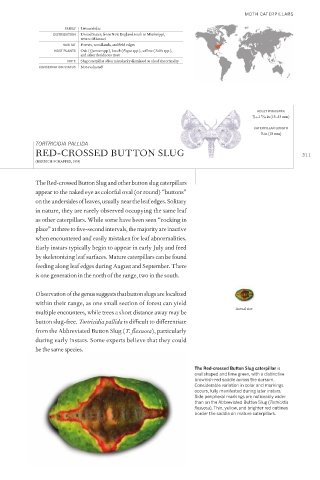
                                                               The Red-crossed Button Slug caterpillar is
                                                               oval shaped and lime green, with a distinctive
                                                               brownish-red saddle across the dorsum.
                                                               Considerable variation in color and markings
                                                               occurs, fully manifested during later instars.
                                                               Side peripheral markings are noticeably wider
                                                               than on the Abbreviated Button Slug (Tortricidia
                                                                 exuosa). Thin, yellow, and brighter red outlines
                                                               border the saddle on mature caterpillars.

