


Page 314 - The Book of Caterpillars: A Life-Size Guide to Six Hundred Species From Around the World
P. 314
MOTH CATERPILLARS

                                                     FAMILY  Zygaenidae
                                                 DISTRIBUTION
                                                 DIS TRIBUTION  Southwestern China
                                                 DISTRIBUTION
                                                    HABIT A T  Elevated forests and urban ornamental plantings
                                                    HABITAT
                                                    HABITAT
                                                  HOST PLANTS
                                                  HOS
                                                  HOST PLANTS S  Prunus cerasoides and P. majestica
                                                    T PLANT

                                                      NOTE
                                                      NO
                                                      NOTE  Defoliating, distasteful caterpillar of a day- ying moth
                                                       TE
                                             CONSERVATION STATUS
                                             CONSERVATION STATUS
                                             CONSERV A TION S T A TUS  Not evaluated, but can be very common in parts of its range
                                                          and elsewhere rarely seen
            ADULT WINGSPAN
             3⅜ in (85 mm)
           CATERPILLAR LENGTH
             1 ⁄   in (30 mm)
                                                                       ACHELURA YUNNANENSIS
                                                 ACHELURA YUNNANENSIS
    312
                                                                                  HORIE & XUE, 1999


                                            Achelura yunnanensis caterpillars can occur in huge numbers
                                            on host plants. They have only one generation annually, with
                                            the late instar caterpillars leaving the host plant to pupate in
                                            late summer. The silk-wrapped pupa is formed in adjoining
                                            evergreen foliage or in the leaf litter to overwinter, as the host
                                            plant is deciduous but often already defoliated by the larvae. The
                                            moths emerge the following summer en masse.


                                            Typical of most caterpillars of the subfamily Chalcosiinae,
                                            Achelura yunnanensis, when threatened, secretes a transparent,
                                            viscous liquid from glands associated with its numerous body
                                            verrucae. These droplets contain cyanoglucosides, which act
                                            as a taste deterrent against natural enemies; the distastefulness
                                            is passed on to the adult moth. The moths are high-flying,

                                            day- ying butter y mimics and do not travel far from the host

                                            plant, so are rarely seen or identi ed. Members of the genus

                                            Achelura, including A. yunnanensis, have only recently been
                                            described, with new discoveries still to be made.


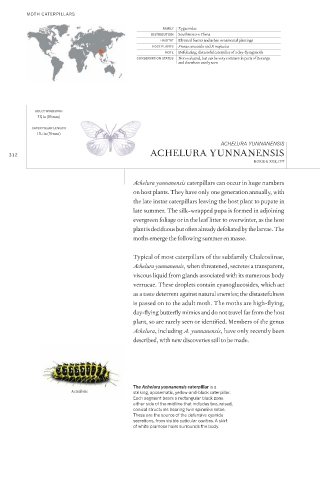
                                            The Achelura yunnanensis caterpillar is a
                        Actual size         striking, aposematic, yellow-and-black caterpillar.
                                            Each segment bears a rectangular black zone
                                            either side of the midline that includes two, raised,
                                            conical structures bearing twin spinelike setae.
                                            These are the source of the defensive cyanide
                                            secretions, from visible cuticular cavities. A skirt
                                            of white plumose hairs surrounds the body.

