


Page 27 - The Book of Caterpillars: A Life-Size Guide to Six Hundred Species From Around the World
P. 27
CATERPILLAR DEFENSES


            leaf-eating caterpillars are green, blending into the foliage, while those that

            feed on flowers may match the red, yellow, or white markings of their
            flower food, or the colors of other plant parts. Grass-feeding caterpillars
            are often green with paler stripes, while a number of Geometridae moth
            caterpillars are convincingly twiglike in appearance. The Camouflaged

            Looper moth caterpillar (Synchlora aerata) takes disguise a step further,
            adorning its body with petals and other plant fragments.
               Some species have bolder markings, often white or
            yellow, that break up the background color, blurring
            their outline. Posture can also change a caterpillar’s

            appearance. For instance, mid-instar caterpillars of the
            California Sister (Adelpha californica) rest in a Loch
            Ness Monster-type posture, making them disappear
            against the lobed oak leaves of their host tree. Others

            mimic bird droppings, such as the early instars of many
            swallowtail species of the Papilionidae family, which
            are black or dark brown with a white “saddle.”


            FRASS DEFENSES
            Reducing telltale odors is a further protective measure.

            Most invertebrate enemies of caterpillars find their prey
            by scent. One likely significant source is caterpillar
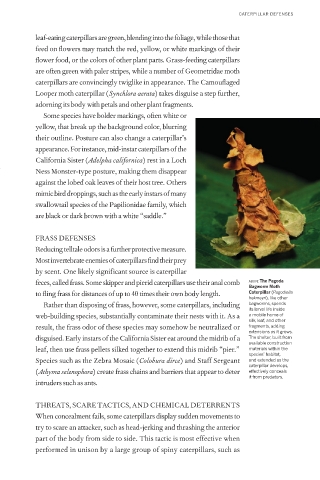
            feces, called frass. Some skipper and pierid caterpillars use their anal comb   above The Pagoda
                                                                                Bagworm Moth
            to fling frass for distances of up to 40 times their own body length.  Caterpillar (Pagodiella
                                                                                hekmeyri), like other
               Rather than disposing of frass, however, some caterpillars, including   bagworms, spends
                                                                                its larval life inside
            web-building species, substantially contaminate their nests with it. As a   a mobile home of
                                                                                silk, leaf, and other
            result, the frass odor of these species may somehow be neutralized or   fragments, adding
                                                                                extensions as it grows.
            disguised. Early instars of the California Sister eat around the midrib of a   The shelter, built from
                                                                                available construction
            leaf, then use frass pellets silked together to extend this midrib “pier.”   materials within the
                                                                                species’ habitat,
            Species such as the Zebra Mosaic (Colobura dirce) and Staff Sergeant   and extended as the
                                                                                caterpillar develops,
            (Athyma selenophora) create frass chains and barriers that appear to deter   effectively conceals
                                                                                it from predators.
            intruders such as ants.


            THREATS, SCARE TACTICS, AND CHEMICAL DETERRENTS
            When concealment fails, some caterpillars display sudden movements to
            try to scare an attacker, such as head-jerking and thrashing the anterior
            part of the body from side to side. This tactic is most effective when
            performed in unison by a large group of spiny caterpillars, such as

