


Page 28 - The Book of Caterpillars: A Life-Size Guide to Six Hundred Species From Around the World
P. 28
CATERPILLAR DEFENSES


                           mid-instar Mourning Cloak (Nymphalis antiopa) larvae. Late instar

                           California Sister caterpillars thrash, and display and move their mandibles
                           as if to bite. Mature caterpillars of some swallowtail butterfly and hawkmoth
                           species have eyespots on the thorax, which are enlarged when the larva is
                           threatened, often giving it the appearance of a small snake. Similarly, the
          below When under
          threat, mature   head capsules of some larvae and the pupal heads of many Hesperiidae
          caterpillars of certain
          species, like this   species have markings or modifications that resemble a vertebrate face,
          Common Rippled
          Hawkmoth (Eupanacra   which again could deter a potential attacker. Other nymphalid caterpillars
          mydon), puff up their
          anterior segments,   have elongated horns at one or both ends of the body, which are waved
          conceal their true
          legs, and enlarge their   around in a threatening manner if a predator approaches.
          eyespots, giving them
          the appearance of a   The spiny armature of many caterpillars turns soft, palatable larvae into
    26    small snake.
                           prickly, tongue-stabbing mouthfuls that only a few predators can tolerate.
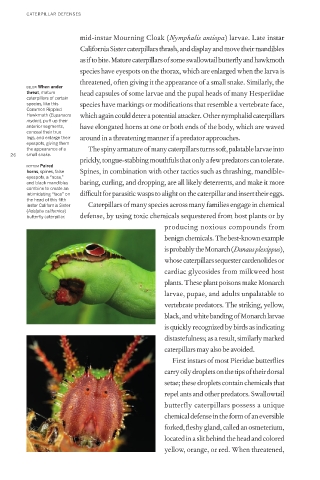
          bottom Paired
          horns, spines, false   Spines, in combination with other tactics such as thrashing, mandible-
          eyespots, a “nose,”
          and black mandibles   baring, curling, and dropping, are all likely deterrents, and make it more
          combine to create an
          intimidating “face” on   difficult for parasitic wasps to alight on the caterpillar and insert their eggs.
          the head of this fifth
          instar California Sister   Caterpillars of many species across many families engage in chemical
          (Adelpha californica)
          butterfly caterpillar.   defense, by using toxic chemicals sequestered from host plants or by
                                                     producing noxious compounds from
                                                     benign chemicals. The best-known example
                                                     is probably the Monarch (Danaus plexippus),

                                                     whose caterpillars sequester cardenolides or
                                                     cardiac glycosides from milkweed host
                                                     plants. These plant poisons make Monarch
                                                     larvae, pupae, and adults unpalatable to

                                                     vertebrate predators. The striking, yellow,
                                                     black, and white banding of Monarch larvae
                                                     is quickly recognized by birds as indicating
                                                     distastefulness; as a result, similarly marked
                                                     caterpillars may also be avoided.

                                                        First instars of most Pieridae butterflies
                                                     carry oily droplets on the tips of their dorsal
                                                     setae; these droplets contain chemicals that
                                                     repel ants and other predators. Swallowtail

                                                     butterfly caterpillars possess a unique
                                                     chemical defense in the form of an eversible
                                                     forked, fleshy gland, called an osmeterium,
                                                     located in a slit behind the head and colored
                                                     yellow, orange, or red. When threatened,

