


Page 375 - The Book of Caterpillars: A Life-Size Guide to Six Hundred Species From Around the World
P. 375
MOTH CATERPILLARS

                      FAMILY  Saturniidae
                  DISTRIBUTION  Central and South America, including Costa Rica, Colombia,
                           and Ecuador
                     HABITAT  Tropical rain forests
                  HOST PLANTS  Mostly members of Malvaceae, including Apeiba spp.,
                           Luehea spp., and Pithecellobiun spp.

                      NOTE  Large, unusual-looking caterpillar that is camou aged by
                           disruptive coloring
             CONSERVATION STATUS  Not evaluated


                                                                                   ADULT WINGSPAN
                                                                                 6⅛–6½ in (155–165 mm)
                                                                                  CATERPILLAR LENGTH
                                                                                   Up to 4 in (100 mm)
            ARSENURA BATESII
            ARSENURA BATESII                                                                     373

            (R. FELDER & ROGENHOFER, 1874)


            The female Arsenura batesii moth lays several hundred creamy-
            white eggs, depositing them singly on the upper surface of
            leaves, so they are scattered through the crowns of the food
            plant trees. The caterpillars hatch and consume their eggshell
            before eating leaves. Although little is known of their feeding
            habits, one of two subspecies, A. batesii Druce, reportedly
            feeds by day on leaves in the tree crown during early instars,
            resting on foliage. In the penultimate instar, however, it is said
            to rest on the trunk by day, returning to the canopy at night,
            and simultaneously changes color from mottled brown green
            to brown black.


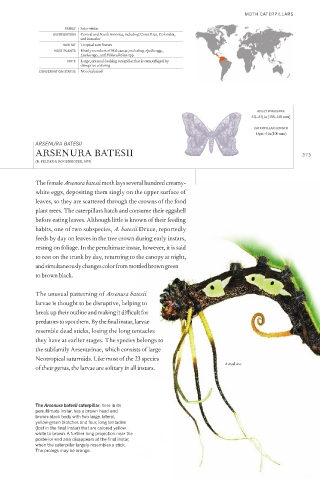
            The unusual patterning of Arsenura batesii
            larvae is thought to be disruptive, helping to

            break up their outline and making it di cult for

            predators to spot them. By the  nal instar, larvae

            resemble dead sticks, losing the long tentacles
            they have at earlier stages. The species belongs to
            the subfamily Arsenurinae, which consists of large
            Neotropical saturniids. Like most of the 23 species
            of their genus, the larvae are solitary in all instars.      Actual size


            The Arsenura batesii caterpillar, here in its
            penultimate instar, has a brown head and
            brown-black body with two large, lateral,
            yellow-green blotches and four, long tentacles
            (lost in the   nal instar) that are colored yellow
            white to brown. A further long projection near the
            posterior end also disappears at the   nal instar,
            when the caterpillar largely resembles a stick.
            The prolegs may be orange.

