


Page 378 - The Book of Caterpillars: A Life-Size Guide to Six Hundred Species From Around the World
P. 378
MOTH CATERPILLARS

                                                     FAMILY  Saturniidae
                                                 DISTRIBUTION  Guiano-Amazonian Basin east of the Andes, from Venezuela
                                                          south to Bolivia
                                                    HABITAT  Tropical forests
                                                  HOST PLANTS  Unknown; in captivity has fed on Black Locust
                                                          (Robinia pseudoacacia)
                                                      NOTE  Giant silkmoth caterpillar that is protected by poisonous,
                                                          stinging spines
                                             CONSERVATION STATUS  Not evaluated


            ADULT WINGSPAN
           2¾–4⅞ in (70–126 mm)
           CATERPILLAR LENGTH
             3½ in (90 mm)
                                                                         AUTOMERIS CURVILINEA
                                                   AUTOMERIS CURVILINEA
    376
                                                                                     SCHAUS, 1906


                                            The beauty of the Automeris curvilinea silkmoth caterpillar
                                            belies the painful reality of its many poisonous stinging spines.
                                            As the caterpillars feed close together, their spines are useful
                                            for shielding themselves and their siblings from vertebrate
                                            predators. When approached by parasitic flies or wasps,
                                            the caterpillars swing their heads back and forth to prevent the
                                            parasitoids from depositing eggs on them. Fortunately, they
                                            usually avoid contact with humans, as most Automeris species
                                            stay in the forest canopy. The mature caterpillars spin   imsy

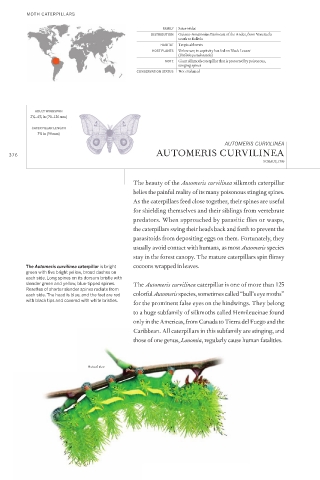
         The Automeris curvilinea caterpillar is bright   cocoons wrapped in leaves.
         green with   ve bright yellow, broad dashes on
         each side. Long spines on its dorsum bristle with
         slender green and yellow, blue-tipped spines.   The Automeris curvilinea caterpillar is one of more than 125
         Rosettes of shorter slender spines radiate from
         each side. The head is blue, and the feet are red   colorful Automeris species, sometimes called “bull’s eye moths”
         with black tips and covered with white bristles.  for the prominent false eyes on the hindwings. They belong
                                            to a huge subfamily of silkmoths called Hemileucinae found
                                            only in the Americas, from Canada to Tierra del Fuego and the
                                            Caribbean. All caterpillars in this subfamily are stinging, and
                                            those of one genus, Lonomia, regularly cause human fatalities.


                             Actual size

