


Page 377 - The Book of Caterpillars: A Life-Size Guide to Six Hundred Species From Around the World
P. 377
MOTH CATERPILLARS

                      FAMILY  Saturniidae
                  DISTRIBUTION  The Philippines
                     HABITAT  Tropical and subtropical forests
                  HOST PLANTS  Many, including lilac (Syringa spp.), willow (Salix spp.),
                           and plum (Prunus spp.)
                      NOTE  Large caterpillar of one of the largest giant silkmoths
             CONSERVATION STATUS  Not evaluated, but limited range


                                                                                   ADULT WINGSPAN
                                                                                  Up to 9⅞ in (250 mm)
                                                                                  CATERPILLAR LENGTH
                                                                                    4⅝ in (120 mm)
            ATTACUS CAESAR
            CAESAR ATLAS SILKMOTH                                                                375

            MAASEN & WEYMER, 1873


            The caterpillar of the Caesar Atlas Silkmoth is large and eats
            many leaves every day, so a small tree cannot support more
            than one or two without attracting hungry birds or insect
            parasites. The caterpillar has a defensive ability to spray the
            enzyme tyrosinase from glands in its integument, which inhibits
            predators; it is also covered with powdery wax that could give
            it some protection. If a small tree is completely defoliated,

            the caterpillar moves to another tree. After the  fth instar, the
            caterpillar spins an immense papery, silk cocoon.

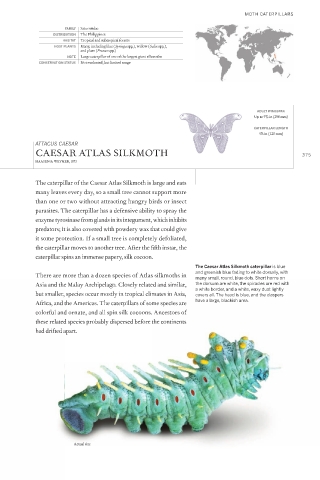
                                                               The Caesar Atlas Silkmoth caterpillar is blue
            There are more than a dozen species of Atlas silkmoths in   and greenish blue fading to white dorsally, with
                                                               many small, round, blue dots. Short horns on
            Asia and the Malay Archipelago. Closely related and similar,   the dorsum are white, the spiracles are red with
            but smaller, species occur mostly in tropical climates in Asia,   a white border, and a white, waxy dust lightly
                                                               covers all. The head is blue, and the claspers
            Africa, and the Americas. The caterpillars of some species are   have a large, blackish area.
            colorful and ornate, and all spin silk cocoons. Ancestors of
            these related species probably dispersed before the continents
            had drifted apart.


                         Actual size

