


Page 372 - The Book of Caterpillars: A Life-Size Guide to Six Hundred Species From Around the World
P. 372
MOTH CATERPILLARS

                                                     FAMILY  Saturniidae
                                                 DISTRIBUTION  Madagascar and the Comoros Islands
                                                    HABITAT  Wet and dry forests
                                                  HOST PLANTS  Many trees and shrubs, including Oleander (Nerium oleander),
                                                          privet (Ligustrum spp.), willow (Salix spp.), and beech (Fagus spp.)
                                                      NOTE  Variably colored silkmoth caterpillar that forms an edible pupa
                                             CONSERVATION STATUS  Not evaluated, but generally common


            ADULT WINGSPAN
           4–5 in (100–130 mm)
           CATERPILLAR LENGTH
           2⅜–2¾ in (60–70 mm)
                                                                            ANTHERINA SURAKA
                                                            SURAKA SILKMOTH
    370
                                                                                  (BOISDUVAL, 1833)


                                            The colors of Suraka Silkmoth caterpillars vary considerably,
                                            ranging from black with orange spines to green with pink spines.
                                            The larvae consume a large amount of vegetation from many

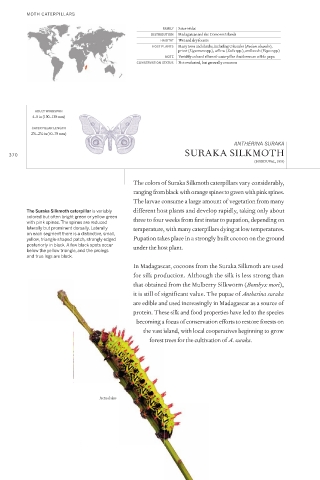
          The Suraka Silkmoth caterpillar is variably   different host plants and develop rapidly, taking only about
          colored but often bright green or yellow green   three to four weeks from  rst instar to pupation, depending on

          with pink spines. The spines are reduced
          laterally but prominent dorsally. Laterally   temperature, with many caterpillars dying at low temperatures.
          on each segment there is a distinctive, small,
          yellow, triangle-shaped patch, strongly edged   Pupation takes place in a strongly built cocoon on the ground
          posteriorly in black. A few black spots occur   under the host plant.
          below the yellow triangle, and the prolegs
          and true legs are black.
                                            In Madagascar, cocoons from the Suraka Silkmoth are used
                                            for silk production. Although the silk is less strong than
                                            that obtained from the Mulberry Silkworm (Bombyx mori),
                                            it is still of significant value. The pupae of Antherina suraka
                                            are edible and used increasingly in Madagascar as a source of
                                            protein. These silk and food properties have led to the species

                                             becoming a focus of conservation e orts to restore forests on
                                               the vast island, with local cooperatives beginning to grow
                                                 forest trees for the cultivation of A. suraka.


                                 Actual size

