


Page 371 - The Book of Caterpillars: A Life-Size Guide to Six Hundred Species From Around the World
P. 371
MOTH CATERPILLARS

                      FAMILY  Saturniidae
                  DISTRIBUTION  United States and southern Canada
                     HABITAT  Deciduous woodlands, although common wherever food plants
                           are found
                  HOST PLANTS  Decidous trees, including apple (Malus spp.), chokecherry
                           (Prunus spp.), chestnut (Castanea spp.), oak (Quercus spp.),
                           sycamore (Platanus spp.), and willow (Salix spp.)
                      NOTE  Caterpillar that regurgitates its food if threatened
             CONSERVATION STATUS  Not evaluated, but common throughout most of its range


                                                                                   ADULT WINGSPAN
                                                                                  4–6	    in (102–152 mm)
                                                                                  CATERPILLAR LENGTH
                                                                                    4 in (102 mm)
            ANTHERAEA POLYPHEMUS
            POLYPHEMUS MOTH                                                                      369

            (CRAMER, 1776)


            Polyphemus Moth caterpillars hatch from large, flattened,
            round eggs that have a band of brown along the outside edge.
            They are solitary feeders and rarely found in close proximity
            to each other. When threatened, the larvae regurgitate their
            food, covering their bodies in a greenish-brown liquid in a bid
            to deter predators. Though their green coloration acts as an
            e ective camou age, the large size of  fth instar larvae makes


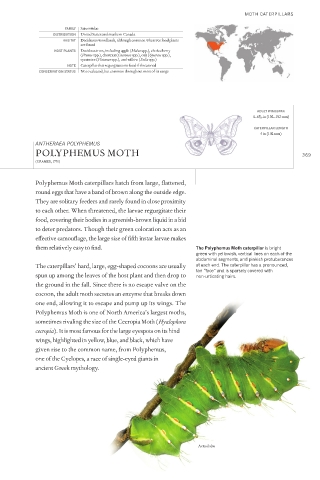
            them relatively easy to  nd.                        The Polyphemus Moth caterpillar is bright
                                                                green with yellowish, vertical lines on each of the
                                                                abdominal segments, and pinkish protuberances
            The caterpillars’ hard, large, egg-shaped cocoons are usually   at each end. The caterpillar has a pronounced,
            spun up among the leaves of the host plant and then drop to   tan “face” and is sparsely covered with
                                                                non-urticating hairs.
            the ground in the fall. Since there is no escape valve on the
            cocoon, the adult moth secretes an enzyme that breaks down
            one end, allowing it to escape and pump up its wings. The
            Polyphemus Moth is one of North America’s largest moths,
            sometimes rivaling the size of the Cecropia Moth (Hyalophora
            cecropia). It is most famous for the large eyespots on its hind
            wings, highlighted in yellow, blue, and black, which have
            given rise to the common name, from Polyphemus,
            one of the Cyclopes, a race of single-eyed giants in
            ancient Greek mythology.


                                                                Actual size

