


Page 376 - The Book of Caterpillars: A Life-Size Guide to Six Hundred Species From Around the World
P. 376
MOTH CATERPILLARS

                                                     FAMILY  Saturniidae
                                                 DISTRIBUTION  Much of southern Asia and China, Southeast Asia
                                                    HABITAT  Tropical and subtropical forests
                                                  HOST PLANTS  Deciduous trees and bushes, including Avocado (Persea
                                                          americana), cherry (Prunus spp.), lilac (Syringa spp.),
                                                          rhododendron (Rhododendron spp.), and willow (Salix spp.)
                                                      NOTE  One of the world’s largest caterpillars
                                             CONSERVATION STATUS  Not evaluated, but common throughout most of its range


            ADULT WINGSPAN
           9–11 in (228–280 mm)
           CATERPILLAR LENGTH
          4½–4	     in (114–127 mm)
                                                                                ATTACUS ATLAS
                                                                      ATLAS MOTH
    374
                                                                                   (LINNAEUS, 1758)


                                            Atlas Moth caterpillars hatch from large, cream-colored eggs
                                            with reddish-brown spots. The larvae eat almost anything
                                            and sometimes leave one species of host plant for another—
                                            a rare trait among caterpillars. All six instars look similar, and
                                            with each successive instar the larva covers its body in a white,
                                            waxy substance that resembles powder. It is thought that this
                                            may help give the appearance of a fungus growing on the
                                            caterpillar, making it unappetizing to predators. The powder
                                            can become so thick that the actual color of the caterpillar is

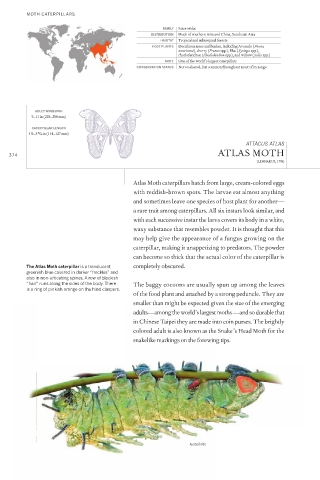
         The Atlas Moth caterpillar is a translucent   completely obscured.
         greenish blue covered in darker “freckles” and
         also in non-urticating spines. A row of blackish
         “hair” runs along the sides of the body. There   The baggy cocoons are usually spun up among the leaves
         is a ring of pinkish orange on the hind claspers.
                                            of the food plant and attached by a strong peduncle. They are
                                            smaller than might be expected given the size of the emerging
                                            adults—among the world’s largest moths —and so durable that
                                            in Chinese Taipei they are made into coin purses. The brightly
                                            colored adult is also known as the Snake’s Head Moth for the
                                            snakelike markings on the forewing tips.


                                                             Actual size

