


Page 374 - The Book of Caterpillars: A Life-Size Guide to Six Hundred Species From Around the World
P. 374
MOTH CATERPILLARS

                                                     FAMILY  Saturniidae
                                                 DIS
                                                 DISTRIBUTION  Eastern Mexico, south to Bolivia and southern Brazil
                                                   TRIBUTION
                                                 DISTRIBUTION
                                                    HABITAT
                                                    HABITAT
                                                    HABIT A T  Tropical forests
                                                    T PLANT
                                                  HOS
                                                  HOST PLANTS S  Ceiba spp. and other trees of the Bombacaceae family
                                                  HOST PLANTS
                                                      NOTE
                                                      NOTE
                                                      NO TE  Highly social caterpillar of giant silkmoth family
                                                      TUS
                                                      A
                                                     T
                                             CONSERVATION STATUS  Not evaluated
                                                 A
                                             CONSERV
                                             CONSERVATION STATUS
                                                  TION S
            ADULT WINGSPAN
          4⅜–6¾ in (115–170 mm)
           CATERPILLAR LENGTH
             4¼ in (110 mm)
                                                                             ARSENURA ARMIDA
                                                            ARSENURA ARMIDA
    372
                                                                                     CRAMER, 1779
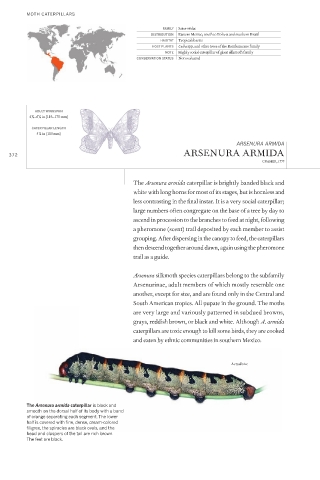
                                            The Arsenura armida caterpillar is brightly banded black and
                                            white with long horns for most of its stages, but is hornless and

                                            less contrasting in the  nal instar. It is a very social caterpillar;
                                            large numbers often congregate on the base of a tree by day to
                                            ascend in procession to the branches to feed at night, following
                                            a pheromone (scent) trail deposited by each member to assist
                                            grouping. After dispersing in the canopy to feed, the caterpillars
                                            then descend together around dawn, again using the pheromone
                                            trail as a guide.


                                            Arsenura silkmoth species caterpillars belong to the subfamily
                                            Arsenurinae, adult members of which mostly resemble one
                                            another, except for size, and are found only in the Central and
                                            South American tropics. All pupate in the ground. The moths
                                            are very large and variously patterned in subdued browns,
                                            grays, reddish brown, or black and white. Although A. armida
                                            caterpillars are toxic enough to kill some birds, they are cooked
                                            and eaten by ethnic communities in southern Mexico.


                                                                           Actual size


          The Arsenura armida caterpillar is black and
          smooth on the dorsal half of its body with a band
          of orange separating each segment. The lower
          half is covered with   ne, dense, cream-colored
            ligree, the spiracles are black ovals, and the
          head and claspers of the tail are rich brown.
          The feet are black.

