


Page 370 - The Book of Caterpillars: A Life-Size Guide to Six Hundred Species From Around the World
P. 370
MOTH CATERPILLARS

                                                     FAMILY  Saturniidae
                                                   TRIBUTION
                                                 DISTRIBUTION
                                                 DISTRIBUTION  Spain, India, China, and Japan
                                                 DIS
                                                    HABIT
                                                    HABITAT T  Oak woodlands
                                                    HABITAT
                                                       A
                                                  HOS
                                                  HOST PLANTS
                                                  HOST PLANTS S  Oak (Quercus spp.)
                                                    T PLANT
                                                      NO
                                                      NOTE  Caterpillar that has produced Tussah silk since 200
                                                       TE
                                                      NOTE
                                             CONSERVATION STATUS  Not evaluated
                                             CONSERVATION STATUS
                                             CONSERV
                                                     T
                                                  TION S
                                                      A
                                                      TUS
                                                 A
            ADULT WINGSPAN
           4¼–6 in (110–150 mm)
           CATERPILLAR LENGTH
             3⅜ in (85 mm)
                                                                            ANTHERAEA PERNYI
                                             CHINESE TUSSAH SILKMOTH
    368
                                                                              (GUÉRIN-MÉNEVILLE, 1855)
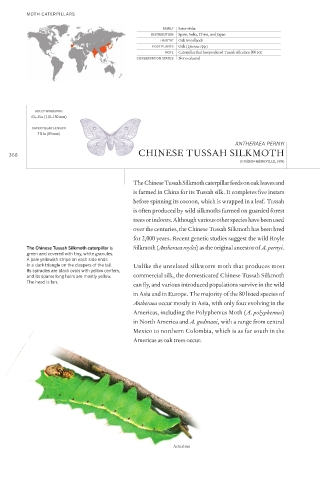
                                            The Chinese Tussah Silkmoth caterpillar feeds on oak leaves and
                                            is farmed in China for its Tussah silk. It completes  ve instars

                                            before spinning its cocoon, which is wrapped in a leaf. Tussah
                                            is often produced by wild silkmoths farmed on guarded forest
                                            trees or indoors. Although various other species have been used
                                            over the centuries, the Chinese Tussah Silkmoth has been bred
                                            for 2,000 years. Recent genetic studies suggest the wild Royle

          The Chinese Tussah Silkmoth caterpillar is   Silkmoth (Antheraea roylei) as the original ancestor of A. pernyi.
          green and covered with tiny, white granules.
          A pale yellowish stripe on each side ends
          in a dark triangle on the claspers of the tail.   Unlike the unrelated silkworm moth that produces most
          Its spiracles are black ovals with yellow centers,
          and its sparse long hairs are mostly yellow.   commercial silk, the domesticated Chinese Tussah Silkmoth
          The head is tan.                  can  y, and various introduced populations survive in the wild

                                            in Asia and in Europe. The majority of the 80 listed species of
                                            Antheraea occur mostly in Asia, with only four evolving in the
                                            Americas, including the Polyphemus Moth (A. polyphemus)
                                            in North America and A. godmani, with a range from central
                                            Mexico to northern Colombia, which is as far south in the
                                            Americas as oak trees occur.


                                                        Actual size

