


Page 373 - The Book of Caterpillars: A Life-Size Guide to Six Hundred Species From Around the World
P. 373
MOTH CATERPILLARS

                      FAMILY  Saturniidae
                  DISTRIBUTION  From Nepal southeast through Myanmar and Thailand to
                           Vietnam, and south to Malaysia
                     HABITAT  Mountain forests
                  HOST PLANTS  Many, including Ailanthus spp. and Kashi Holly (Ilex chinensis)
                      NOTE  Large, polyphagous caterpillar of the largest moth in Asia
             CONSERVATION STATUS  Not evaluated


                                                                                   ADULT WINGSPAN
                                                                                  Up to 9⅞ in (250 mm)
                                                                                  CATERPILLAR LENGTH
                                                                                    6 in (150 mm)
            ARCHAEOATTACUS EDWARDSI
            EDWARDS ATLAS SILKMOTH                                                               371

            WHITE, 1859


            The Edwards Atlas Silkmoth caterpillar grows large, with the
            ability to feed on a variety of plants in the wild. In captivity, it has
            fed on ailanthus, privet (Ligustrum spp.), poplar (Populus spp.),
            willow (Salix spp.), lilac (Syringa spp.), and other plants. The
             rst instar is white with narrow black bands. Subsequent instars

            are white and thickly covered in powdery wax, but the greenish
            fifth and last instar is more lightly covered. Recent genetic
            evidence suggests there are three species of Archaeoattacus
            instead of two as previously believed, all from Asia.


            Currently, the Edwards Atlas Silkmoth is placed evolutionarily
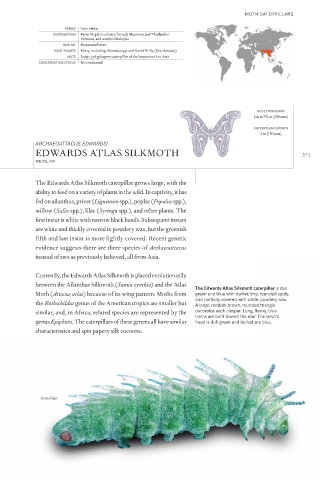
            between the Ailanthus Silkmoth (Samia cynthia) and the Atlas   The Edwards Atlas Silkmoth caterpillar is dull
            Moth (Attacus atlas) because of its wing pattern. Moths from   green and blue with darker, tiny, rounded spots,
            the Rothschildia genus of the American tropics are smaller but   and partially covered with white, powdery wax.
                                                               A large, reddish-brown, rounded triangle
            similar, and, in Africa, related species are represented by the   decorates each clasper. Long,   eshy, blue
            genus Epiphora. The caterpillars of these genera all have similar   horns are bent toward the rear. The larva’s
                                                               head is dull green and its feet are blue.
            characteristics and spin papery silk cocoons.


              Actual size

