


Page 381 - The Book of Caterpillars: A Life-Size Guide to Six Hundred Species From Around the World
P. 381
MOTH CATERPILLARS

                      FAMILY  Saturniidae
                  DIS
                    TRIBUTION
                  DISTRIBUTION  Guiano-Amazonian region, from Venezuela to Bolivia and Brazil
                  DISTRIBUTION
                     HABIT A T  Tropical forests
                     HABITAT
                     HABITAT
                  HOST PLANTS S  Unknown; in captivity has fed on Erythrina spp.
                    T PLANT
                  HOST PLANTS
                  HOS

                        TE
                      NO
                      NOTE  Decorative and  erce giant silkmoth caterpillar
                      NOTE
             CONSERVATION STATUS
             CONSERVATION STATUS
             CONSERV A TION S T A TUS  Not evaluated
                                                                                   ADULT WINGSPAN
                                                                                  3¼–5¾ in (82–147 mm)
                                                                                  CATERPILLAR LENGTH
                                                                                    4¼ in (110 mm)
            AUTOMERIS LARRA
            AUTOMERIS LARRA                                                                      379
            (WALKER, 1855)


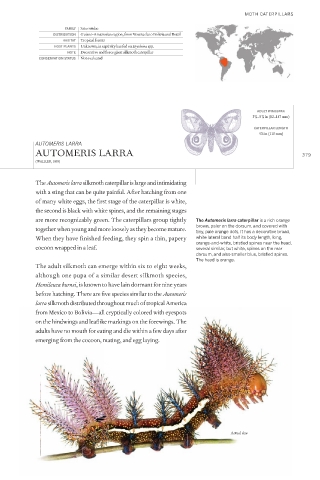
            The Automeris larra silkmoth caterpillar is large and intimidating
            with a sting that can be quite painful. After hatching from one

            of many white eggs, the  rst stage of the caterpillar is white,
            the second is black with white spines, and the remaining stages
            are more recognizably green. The caterpillars group tightly   The Automeris larra caterpillar is a rich orange
            together when young and more loosely as they become mature.   brown, paler on the dorsum, and covered with
                                                                tiny, pale orange dots. It has a decorative broad,
            When they have finished feeding, they spin a thin, papery   white lateral band half its body length, long,
            cocoon wrapped in a leaf.                           orange-and-white, bristled spines near the head,
                                                                several similar, but white, spines on the rear
                                                                dorsum, and also smaller blue, bristled spines.
                                                                The head is orange.
            The adult silkmoth can emerge within six to eight weeks,
            although one pupa of a similar desert silkmoth species,
            Hemileuca burnsi, is known to have lain dormant for nine years

            before hatching. There are  ve species similar to the Automeris
            larra silkmoth distributed throughout much of tropical America
            from Mexico to Bolivia—all cryptically colored with eyespots
            on the hindwings and lea ike markings on the forewings. The

            adults have no mouth for eating and die within a few days after
            emerging from the cocoon, mating, and egg laying.


                                                                           Actual size

