


Page 382 - The Book of Caterpillars: A Life-Size Guide to Six Hundred Species From Around the World
P. 382
MOTH CATERPILLARS

                                                     FAMILY  Saturniidae
                                                 DISTRIBUTION  Most of Africa south of the Sahara, Madagascar
                                                    HABITAT  Tropical forests and savannahs
                                                  HOST PLANTS  Various, including Castor Bean (Ricinus communis),
                                                          Guava (Psidium guajava), and mango (Mangifera spp.)
                                                      NOTE  Caterpillar that is used as a food in southern Africa
                                             CONSERVATION STATUS  Not evaluated, but widespread through much of Africa


            ADULT WINGSPAN
          4¼–6⅜ in (110–160 mm)
           CATERPILLAR LENGTH
             3½ in (90 mm)
                                                                              BUNAEA ALCINOE
                                                  CABBAGE TREE EMPEROR
    380
                                                                                     (STOLL, 1780)


                                            The strikingly colored Cabbage Tree Emperor caterpillar
                                            is big, and in great numbers it can completely defoliate large

                                            trees. After  nishing feeding in the  fth instar, the caterpillar

                                            evacuates its gut and burrows into the soil to form a chamber and
                                            pupate. Larger larvae are eaten by gorillas and are also gathered
                                            for human food, reportedly at the  fth or sixth instar or even

                                            after they have burrowed into the ground. They add excellent
                                            nutrients to a diet that is often inadequate, and are also canned
                                            and sold in grocery stores.


                                            The beautiful moth is abundant throughout much of Africa, but
                                            there is disagreement among lepidopterists as to whether the
                                            populations in Kenya and Madagascar, named Bunaea auslaga,
                                            represent a subspecies or a distinct species. Alcinoe, after
                                            whom the Cabbage Tree Emperor was named, was, in Greek
                                             mythology, the daughter of King Polybus of Corinth, who
                                                     was also the adoptive father of Oedipus.


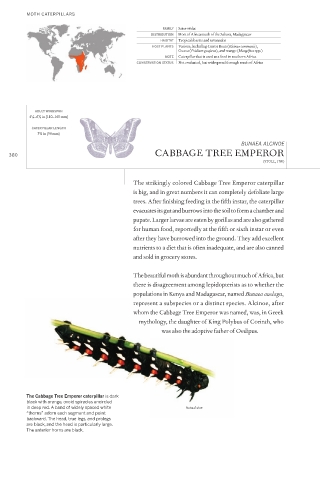
         The Cabbage Tree Emperor caterpillar is dark
         black with orange, ovoid spiracles encircled
         in deep red. A band of widely spaced white         Actual size
         “thorns” adorn each segment and point
         backward. The head, true legs, and prolegs
         are black, and the head is particularly large.
         The anterior horns are black.

