


Page 383 - The Book of Caterpillars: A Life-Size Guide to Six Hundred Species From Around the World
P. 383
MOTH CATERPILLARS

                      FAMILY  Saturniidae
                  DISTRIBUTION  India (Assam), China (Yunnan), eastern Myanmar, and Thailand
                     HABITAT  Mountain forests
                  HOST PLANTS  Many, including walnut (Juglans spp.), willow (Salix spp.),
                           and oak (Quercus spp.)
                      NOTE  Striking, multicolored silkmoth caterpillar
             CONSERVATION STATUS  Not evaluated


                                                                                   ADULT WINGSPAN
                                                                                  2⅞–3¾ in (73–95 mm)
                                                                                  CATERPILLAR LENGTH
                                                                                    2 ⁄   in (65 mm)
            CALIGULA CACHARA
            CALIGULA CACHARA                                                                     381

            MOORE, 1872


            The Caligula cachara silkmoth caterpillar hatches from a
            group of irregularly placed eggs, which are partially covered
            with a protective, brown, lacquer-like cement, secreted by the
            female silkmoth as she lays. Newly hatched, the caterpillar is
            mostly blue, but by the end of the  rst instar it becomes green.


            By the  fth and  nal instar it is stunningly marked and colored.

            Throughout its development the caterpillar remains close to its
            siblings and, when  nished feeding, spins a brown cocoon of

            open web netting in which the pupa is plainly visible inside.

            The Caligula genus contains ten species, most of whose eggs
            overwinter before hatching in the spring. It is now sometimes
            considered a subgenus of Saturnia rather than separated as
            Caligula, or its previous name, Dictyoploca. Caligula species are
            distributed mainly in Asia and Japan. The C. cachara caterpillar,
            like most of the others of its genus, possesses very long, pale hair,
            especially on the dorsum.


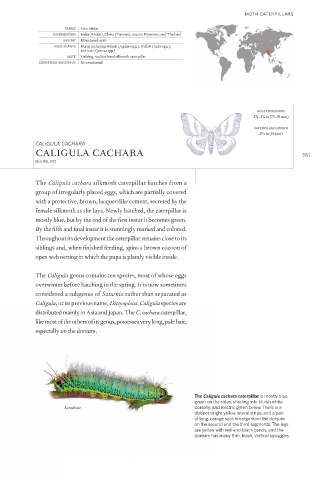
                                                               The Caligula cachara caterpillar is mostly blue
                                                               green on the sides, shading into bluish white
                     Actual size                               dorsally, and electric green below. There is a
                                                               distinct bright yellow lateral stripe, and a pair
                                                               of long, orange scoli emerge from the dorsum
                                                               on the second and the third segments. The legs
                                                               are yellow with red-and-black bands, and the
                                                               dorsum has many thin, black, vertical squiggles.

