


Page 385 - The Book of Caterpillars: A Life-Size Guide to Six Hundred Species From Around the World
P. 385
MOTH CATERPILLARS

                      FAMILY  Saturniidae
                  DISTRIBUTION  Eastern United States into Canada
                     HABITAT  Deciduous woodlands
                  HOST PLANTS  Deciduous trees and bushes, including apple (Malus spp.),
                           Sassafras (Sassafras albidum), cherry (Prunus spp.), poplar
                           (Populus spp.), and Spicebush (Lindera benzoin)
                      NOTE  Caterpillar that is known for making a perfectly

                           camou aged cocoon
             CONSERVATION STATUS  Not evaluated, but one of the more common Saturniidae species


                                                                                   ADULT WINGSPAN
                                                                                  3–3⅜ in (75–85 mm)
                                                                                  CATERPILLAR LENGTH
                                                                                  2–2⅜ in (50–60 mm)
            CALLOSAMIA PROMETHEA
            PROMETHEA MOTH                                                                       383

            (DRURY, 1773)


            Promethea Moth caterpillars hatch from a cluster of 2 to 12
            small, white eggs usually laid in rows on host plants in late spring
            or early summer. Initially the larvae feed in small groups but
            become solitary when they reach later instars. This species is
            single brooded in the north of its range and can have two or
            more broods in the south. When threatened, the caterpillars
            regurgitate their food onto themselves to become less palatable
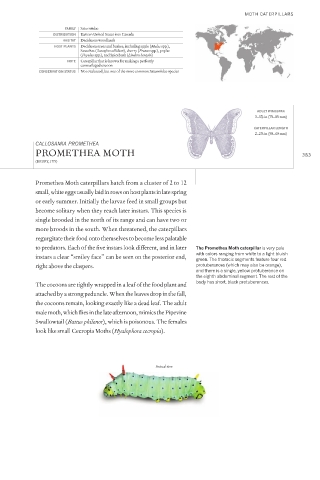
            to predators. Each of the  ve instars look di erent, and in later   The Promethea Moth caterpillar is very pale


            instars a clear “smiley face” can be seen on the posterior end,   with colors ranging from white to a light bluish
                                                                green. The thoracic segments feature four red
            right above the claspers.                           protuberances (which may also be orange),
                                                                and there is a single, yellow protuberance on
                                                                the eighth abdominal segment. The rest of the
            The cocoons are tightly wrapped in a leaf of the food plant and   body has short, black protuberances.
            attached by a strong peduncle. When the leaves drop in the fall,
            the cocoons remain, looking exactly like a dead leaf. The adult
            male moth, which  ies in the late afternoon, mimics the Pipevine

            Swallowtail (Battus philenor), which is poisonous. The females
            look like small Cecropia Moths (Hyalophora cecropia).


                                                   Actual size

