


Page 384 - The Book of Caterpillars: A Life-Size Guide to Six Hundred Species From Around the World
P. 384
MOTH CATERPILLARS

                                                     FAMILY  Saturniidae
                                                 DISTRIBUTION  Pakistan, north India, China, Burma, and Thailand
                                                    HABITAT  Mountain forests at lower elevations
                                                  HOST PLANTS  Walnut (Juglans regia), oak (Quercus spp.), and plum
                                                          (Prunus spp.)
                                                      NOTE  Spring silkmoth caterpillar that hatches from an
                                                          overwintering egg
                                             CONSERVATION STATUS  Not evaluated


            ADULT WINGSPAN
          4⅞–5	     in (125–149 mm)
           CATERPILLAR LENGTH
             4⅛ in (105 mm)
                                                                               CALIGULA SIMLA
                                                                CALIGULA SIMLA
    382
                                                                                  (WESTWOOD, 1847)


                                            The Caligula simla silkmoth follows a seasonal pattern that

                                            di ers from that of many other species. Instead of breeding in
                                            the spring, C. simla adults emerge in the fall, mate, and lay eggs
                                            that overwinter and hatch in the spring. The tiny caterpillars
                                            of the  rst instar are black, and subsequent instars are colorful

                                            combinations of green, blue, red, yellow, black, and white—
                                            very di erent from the mature caterpillars. Later, a silk cocoon

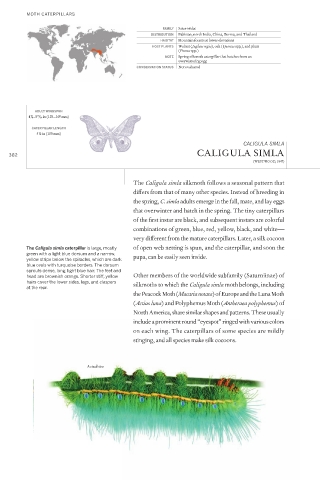
         The Caligula simla caterpillar is large, mostly   of open web netting is spun, and the caterpillar, and soon the
         green with a light blue dorsum and a narrow,   pupa, can be easily seen inside.
         yellow stripe below the spiracles, which are dark
         blue ovals with turquoise borders. The dorsum
         sprouts dense, long, light blue hair. The feet and
         head are brownish orange. Shorter sti  , yellow   Other members of the worldwide subfamily (Saturniinae) of
         hairs cover the lower sides, legs, and claspers   silkmoths to which the Caligula simla moth belongs, including
         at the rear.
                                            the Peacock Moth (Macaria notata) of Europe and the Luna Moth
                                            (Actias luna) and Polyphemus Moth (Antheraea polyphemus) of
                                            North America, share similar shapes and patterns. These usually
                                            include a prominent round “eyespot” ringed with various colors
                                            on each wing. The caterpillars of some species are mildly
                                            stinging, and all species make silk cocoons.


                             Actual size

