


Page 386 - The Book of Caterpillars: A Life-Size Guide to Six Hundred Species From Around the World
P. 386
MOTH CATERPILLARS

                                                     FAMILY  Saturniidae
                                                   TRIBUTION
                                                 DIS
                                                 DISTRIBUTION  Eastern Peru
                                                 DISTRIBUTION
                                                    HABITAT
                                                    HABITAT T  High-altitude cloud forests
                                                    HABIT
                                                       A
                                                  HOST PLANTS
                                                  HOS
                                                  HOST PLANTS S  Unknown; in captivity has fed on Laurel Sumac (Malosma laurina)
                                                    T PLANT
                                                      NO
                                                      NOTE  Rare, high-altitude silkmoth caterpillar
                                                       TE
                                                      NOTE
                                             CONSERVATION STATUS  Not evaluated, but scarce
                                             CONSERV
                                             CONSERVATION STATUS
                                                     T
                                                  TION S
                                                      A
                                                      TUS
                                                 A
            ADULT WINGSPAN
           3–3⅞ in (75–98 mm)
           CATERPILLAR LENGTH
             2¾ in (70 mm)
                                                                         CERODIRPHIA HARRISAE
                                                   CERODIRPHIA HARRISAE
    384
                                                                                    LEMAIRE, 1975
                                            The Cerodirphia harrisae silkmoth caterpillar is so rare that the
                                            adult female has not yet been o cially described. Photographs


                                            of its immature stages were obtained by rearing the eggs of the

                                             rst known female captured in Peru. The newly hatched young
                                            were creamy white and congregated in a tight group on the
                                            leaf edge to feed, moving by turns to the freshly chewed edge.
                                            The caterpillars completed six instars before crawling to the
                                            ground to pupate under humid dead leaves wrapped with a few

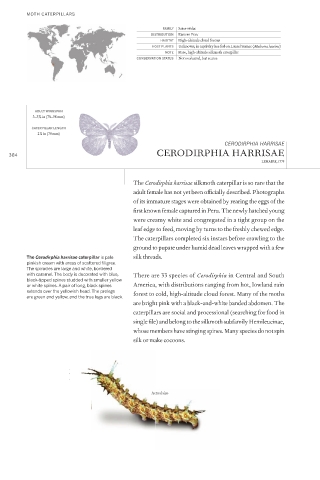
          The Cerodirphia harrisae caterpillar is pale   silk threads.
          pinkish cream with areas of scattered   ligree.
          The spiracles are large and white, bordered
          with caramel. The body is decorated with blue,   There are 33 species of Cerodirphia in Central and South
          black-tipped spines studded with smaller yellow
          or white spines. A pair of long, black spines   America, with distributions ranging from hot, lowland rain
          extends over the yellowish head. The prolegs   forest to cold, high-altitude cloud forest. Many of the moths
          are green and yellow, and the true legs are black.
                                            are bright pink with a black-and-white banded abdomen. The
                                            caterpillars are social and processional (searching for food in

                                            single  le) and belong to the silkmoth subfamily Hemileucinae,
                                            whose members have stinging spines. Many species do not spin
                                            silk or make cocoons.


                                                 Actual size

