


Page 387 - The Book of Caterpillars: A Life-Size Guide to Six Hundred Species From Around the World
P. 387
MOTH CATERPILLARS

                      FAMILY  Saturniidae
                  DISTRIBUTION  Colombia, Ecuador, Peru, and Brazil
                     HABITAT  Woodlands, open areas, and rangeland
                  HOST PLANTS  Wide variety of trees and shrubs, including ash (Fraxinus spp.)
                           and beech (Fagus spp.)
                      NOTE  Large silkmoth caterpillar that comes in two color forms
             CONSERVATION STATUS  Not evaluated, but locally common


                                                                                   ADULT WINGSPAN
                                                                                 4¼–4⅝ in (110–120 mm)
                                                                                  CATERPILLAR LENGTH
                                                                                  4–4⅝ in (100–120 mm)
            CITHERONIA AROA
            CITHERONIA AROA                                                                      385

            SCHAUS, 1896


            Citheronia aroa caterpillars hatch from large, yellowish eggs laid
            singly or in groups of up to four on the upper surface of host
            plant leaves seven to ten days earlier. The early instar caterpillars
            feed mostly by night and rest by day, while later instars
            also feed openly by day. Mature larvae have two color forms,
            which probably evolved to blend in with their variable habitats.
            There are five instars, and development from egg hatch to

            pupation takes  ve to six weeks.
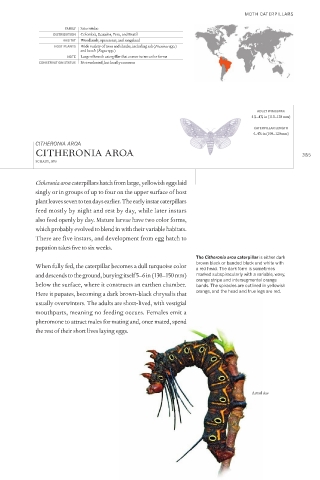
                                                                The Citheronia aroa caterpillar is either dark
            When fully fed, the caterpillar becomes a dull turquoise color   brown black or banded black and white with
                                                                a red head. The dark form is sometimes
            and descends to the ground, burying itself 5–6 in (130–150 mm)   marked subspiracularly with a variable, wavy,
            below the surface, where it constructs an earthen chamber.   orange stripe and intersegmental orange
                                                                bands. The spiracles are outlined in yellowish
            Here it pupates, becoming a dark brown-black chrysalis that   orange, and the head and true legs are red.
            usually overwinters. The adults are short-lived, with vestigial
            mouthparts, meaning no feeding occurs. Females emit a
            pheromone to attract males for mating and, once mated, spend
            the rest of their short lives laying eggs.


                                                                                 Actual size

