


Page 388 - The Book of Caterpillars: A Life-Size Guide to Six Hundred Species From Around the World
P. 388
MOTH CATERPILLARS

                                                     FAMILY  Saturniidae
                                                 DISTRIBUTION  Eastern United States
                                                    HABITAT  Forested areas where host plants are abundant
                                                  HOST PLANTS  Various, including ash (Fraxinus spp.), Buttonbush (Cephalanthus
                                                          occidentalis), hickory (Carya spp.), privet (Ligustrum spp.),
                                                          sweetgum (Liquidambar spp.), and walnut (Juglans spp.)

                                                      NOTE  Caterpillar whose common name re ects its striking appearance
                                             CONSERVATION STATUS  Not evaluated, usually common but now rare in New England


            ADULT WINGSPAN
           3¾–5¾ in (96–147 mm)
           CATERPILLAR LENGTH
             6 in (150 mm)
                                                                           CITHERONIA REGALIS
                                                  HICKORY HORNED DEVIL
    386
                                                                                   (FABRICIUS, 1793)


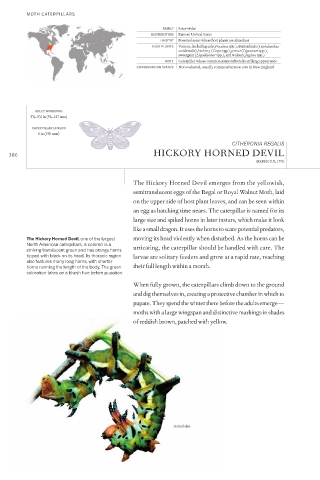
                                            The Hickory Horned Devil emerges from the yellowish,
                                            semitranslucent eggs of the Regal or Royal Walnut Moth, laid
                                            on the upper side of host plant leaves, and can be seen within
                                            an egg as hatching time nears. The caterpillar is named for its
                                            large size and spiked horns in later instars, which make it look
                                            like a small dragon. It uses the horns to scare potential predators,
          The Hickory Horned Devil, one of the largest   moving its head violently when disturbed. As the horns can be
          North American caterpillars, is colored in a   urticating, the caterpillar should be handled with care. The
          striking translucent green and has orange horns
          tipped with black on its head. Its thoracic region   larvae are solitary feeders and grow at a rapid rate, reaching
          also features many long horns, with shorter
          horns running the length of the body. The green   their full length within a month.
          coloration takes on a bluish hue before pupation.
                                            When fully grown, the caterpillars climb down to the ground
                                            and dig themselves in, creating a protective chamber in which to
                                            pupate. They spend the winter there before the adults emerge—
                                            moths with a large wingspan and distinctive markings in shades
                                            of reddish brown, patched with yellow.


                                                        Actual size

