


Page 389 - The Book of Caterpillars: A Life-Size Guide to Six Hundred Species From Around the World
P. 389
MOTH CATERPILLARS

                      FAMILY  Saturniidae
                  DISTRIBUTION  Southeastern Mexico, south to eastern Peru, eastern Bolivia,
                           and Argentina
                     HABITAT  Tropical forests
                  HOST PLANTS  Unknown; in captivity has fed on Black Locust
                           (Robinia pseudoacacia) and willow (Salix spp.)
                      NOTE  One of only two Citioica silkmoth species
             CONSERVATION STATUS  Not evaluated


                                                                                   ADULT WINGSPAN
                                                                                 2	   –4⅛ in (52–106 mm)
                                                                                  CATERPILLAR LENGTH
                                                                                    2⅜ in (60 mm)
            CITIOICA ANTHONILIS
            CITIOICA ANTHONILIS                                                                  387

            (HERRICH-SCHÄFFER, 1854)


            The tiny, black Citioica anthonilis caterpillar hatches from a
            group of green eggs deposited on a leaf or stem about one week
            previously. During the early instars, the larvae remain close
            together, changing to green in the second instar, and acquiring
            more color and complex design as they progress. During the  fth

            and  nal instar, the caterpillar appears threatening, with many

            long, spiky, silver tubercles, although these are soft and harmless

            and cannot sting. After it has  nished feeding, the caterpillar
            burrows into the soil to pupate.


            There are only two species of Citioica. Adults of both are
            almost identical—thick bodied and plain brown with two
            dark lines on the forewing. They belong to the large subfamily
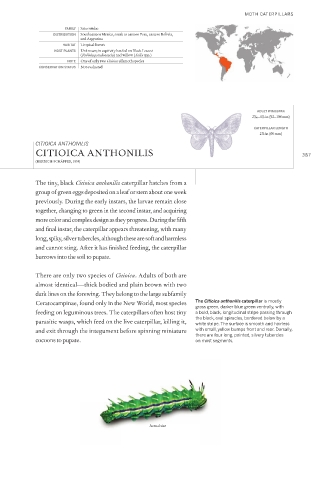
            Ceratocampinae, found only in the New World, most species   The Citioica anthonilis caterpillar is mostly
                                                               grass green, darker blue green ventrally, with
            feeding on leguminous trees. The caterpillars often host tiny   a bold, black, longitudinal stripe passing through
            parasitic wasps, which feed on the live caterpillar, killing it,   the black, oval spiracles, bordered below by a
                                                               white stripe. The surface is smooth and hairless
            and exit through the integument before spinning miniature   with small, yellow bumps front and rear. Dorsally,
                                                               there are four long, pointed, silvery tubercles
            cocoons to pupate.                                 on most segments.


                                                 Actual size

