


Page 422 - The Book of Caterpillars: A Life-Size Guide to Six Hundred Species From Around the World
P. 422
MOTH CATERPILLARS

                                                     FAMILY  Saturniidae
                                                 DISTRIBUTION  Central Chile
                                                    HABITAT  Forests, scrub, and hedgerows
                                                  HOST PLANTS  Maytenus boaria, Cryptocarya rubra, and others
                                                      NOTE  Singular, overwintering Hemileucinae caterpillar that has
                                                          deceptive, large, black “eyes”
                                             CONSERVATION STATUS  Not evaluated


            ADULT WINGSPAN
          2  ⁄  –3 ⁄   in (74–88 mm)
           CATERPILLAR LENGTH
             3 in (75 mm)
                                                                        POLYTHYSANA APOLLINA
                                                 POLYTHYSANA APOLLINA
    420
                                                                           R. FELDER & ROGENHOFER, 1874


                                            The Polythysana apollina caterpillar is unlike those of other
                                            genera of the Hemileucinae subfamily of giant silkmoths, in
                                            both appearance and habits. It does not have large dorsal spines,
                                            is not very urticating, and feeds independently, mostly at night.
                                            It is not processionary, and after only five instars it spins a

                                            large,  u y, white, well-insulated cocoon. When prodded, the

                                            caterpillar expands the dorsum of its  rst and second segments

                                            to reveal two large, black “eyes,” complete with small, white
                                            “glints” surrounded by spiny “eyelashes,” which have evolved
                                            as a defense to scare predators.


                                            The Polythysana genus encompasses three species of brightly
                                            colored moths with red eyespots, all but one con ned to Chile.

                                            The adults emerge in March, Chile’s early fall, and adult males
                                            of several species can be seen simultaneously, undulating here
                                            and there over the low forest on warm, sunny days for less than
                                            two hours around midday, searching for females by locating
                                            pheromone trails. The resulting eggs develop slowly in the
                                            coolness of the season.


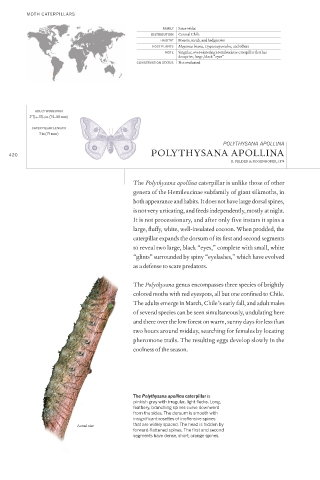
                                            The Polythysana apollina caterpillar is
                                            pinkish gray with irregular, light   ecks. Long,
                                            feathery, branching spines curve downward
                                            from the sides. The dorsum is smooth with
                                            insigni  cant rosettes of ino  ensive spines
                          Actual size       that are widely spaced. The head is hidden by
                                            forward-  attened spines. The   rst and second
                                            segments have dense, short, orange spines.

