


Page 417 - The Book of Caterpillars: A Life-Size Guide to Six Hundred Species From Around the World
P. 417
MOTH CATERPILLARS

                      FAMILY  Saturniidae
                  DISTRIBUTION  Across Australia, but mainly near the east coast
                     HABITAT  Eucalyptus forests
                  HOST PLANTS  Eucalyptus (Eucalyptus spp.) and others, including pine
                           (Pinus spp.), apple (Malus spp.), and Apricot (Prunus armeniaca)
                      NOTE  Giant silkmoth species with pupation lasting up to ten years
             CONSERVATION STATUS  Not evaluated


                                                                                   ADULT WINGSPAN
                                                                                 4¼–5½ in (110–140 mm)
                                                                                  CATERPILLAR LENGTH
                                                                                    3¾ in (95 mm)
            OPODIPHTHERA EUCALYPTI
            EMPEROR GUM MOTH                                                                     415

            (SCOTT, 1864)


            The Emperor Gum Moth caterpillar hatches in the spring or
            summer in Australia (October to March) and begins feeding.
            It is black and white in its  rst stage and progresses through  ve


            larval instars, molting into a larger and di erently colored skin

            each time, ending up mostly green but multicolored in the  nal
            stage. The caterpillar spins a very tough and hard cocoon where
            it pupates. The adult usually emerges the following spring or
            summer, but depending on rainfall the pupa may remain in the
            cocoon for up to ten years before emerging.


            The genus Opodipthera contains from 12 to 20 or more similar
            species, distributed in Australia, New Guinea, and several nearby
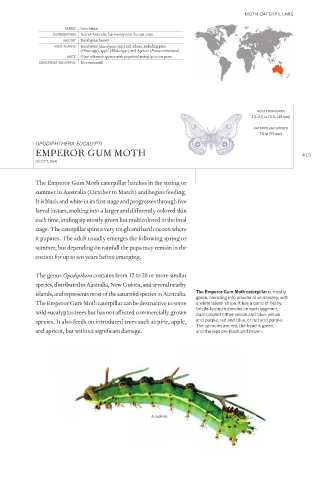
            islands, and represents most of the saturniid species in Australia.   The Emperor Gum Moth caterpillar is mostly
                                                                green, blending into powder blue dorsally, with
            The Emperor Gum Moth caterpillar can be destructive to some   a white lateral stripe. It has a band of   eshy,

            wild eucalyptus trees but has not a ected commercially grown   bristle-tipped tubercles on each segment,
                                                                dual-colored either yellow and blue, yellow
            species. It also feeds on introduced trees such as pine, apple,   and purple, red and blue, or red and purple.
            and apricot, but without signi cant damage.         The spiracles are red, the head is green,

                                                                and the legs are black and brown.


                                                 Actual size

