


Page 419 - The Book of Caterpillars: A Life-Size Guide to Six Hundred Species From Around the World
P. 419
MOTH CATERPILLARS

                      FAMILY  Saturniidae
                  DISTRIBUTION  From Mexico south through Central America to Panama
                     HABITAT  Mostly mid-elevation forests
                  HOST PLANTS  Unknown in the wild; in captivity has fed on a variety of plants,
                           including species of Leguminosae and Rosaceae
                      NOTE  Rarely seen montane, stinging silkmoth caterpillar
             CONSERVATION STATUS  Not evaluated


                                                                                   ADULT WINGSPAN
                                                                                  2⅜–3 in (60–75 mm)
                                                                                  CATERPILLAR LENGTH
                                                                                  2 ⁄  –2¾ in (65–70 mm)
            PARADIRPHIA LASIOCAMPINA
            PARADIRPHIA LASIOCAMPINA                                                             417

            (R. FELDER & ROGENHOFER, 1874)


            Paradirphia lasiocampina caterpillars hatch from pale colored
            eggs laid by the female silkmoth in small batches on host
            plant leaves. The early instars are gregarious, while later
            instars live relatively solitary lives. The larvae develop
            through six instars over a period of between four and six weeks.
            Before pupation, the caterpillars leave the host plant in search
            of a pupation site on the ground. A pupation chamber is formed
            about 4 in (100 mm) below the soil surface, and, unlike most
            other silkmoth caterpillars, this species does not use silk to line
            the chamber. The pupa is black and smooth.


            Caterpillars of this silkmoth are well defended by their clusters
            of spines, which can cause mild to severe stinging in some
            people. There are about 30 described species in the silkmoth
            genus Paradirphia, most of them occurring in Central America
            and South America.


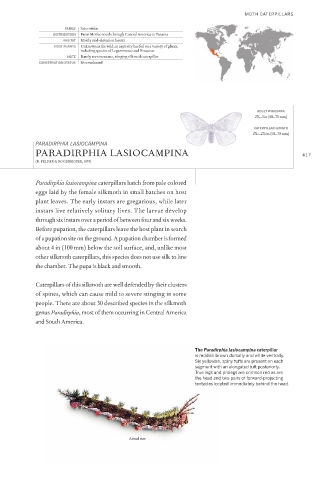
                                                               The Paradirphia lasiocampina caterpillar
                                                               is reddish brown dorsally and white ventrally.
                                                               Six yellowish, spiny tufts are present on each
                                                               segment with an elongated tuft posteriorly.
                                                               True legs and prolegs are crimson red as are
                                                               the head and two pairs of forward-projecting
                                                               tentacles located immediately behind the head.


                                          Actual size

