


Page 426 - The Book of Caterpillars: A Life-Size Guide to Six Hundred Species From Around the World
P. 426
MOTH CATERPILLARS

                                                     FAMILY  Saturniidae
                                                 DISTRIBUTION  Far southeastern Russia, northeastern China, Korean
                                                          Peninsula, and Japan
                                                    HABITAT  Forests
                                                  HOST PLANTS  Trees, including oak (Quercus spp.), maple (Acer spp.),
                                                          walnut (Juglans spp.), and willow (Salix spp.)
                                                      NOTE  Giant silkmoth caterpillar that squeaks when disturbed
                                             CONSERVATION STATUS  Not evaluated


            ADULT WINGSPAN
           4¼–5 in (110–130 mm)
           CATERPILLAR LENGTH
             3⅛ in (80 mm)
                                                                              RHODINIA FUGAX
                                                              RHODINIA FUGAX
    424
                                                                                    (BUTLER, 1877)


                                            The Rhodinia fugax moth caterpillar hatches in early spring after
                                            overwintering as an egg on a twig. In the  rst instar, it is black

                                            on the dorsum and yellow on the sides, but by the third instar the
                                            colors are reversed. During this period the dorsum has rows of
                                            tubercles studded with curved, black bristles, and the caterpillar
                                            groups with its siblings. In the fourth and  fth instars, it becomes

                                            solitary and often hangs motionless beneath a branch, its dark
                                            green ventrum blending with the darkness below, and the
                                            light green dorsum blending with the bright sky above.


                                            The full-grown caterpillars, which are smooth to the touch and
                                            squeak when disturbed, spin a cocoon of green silk, shaped like
                                            a pitcher, with an open top and a small hole in the narrow base.
                                            The moths emerge to mate in the fall, and the females lay their
                                            eggs. There are 11 species of Rhodinia in Japan.


                     Actual size
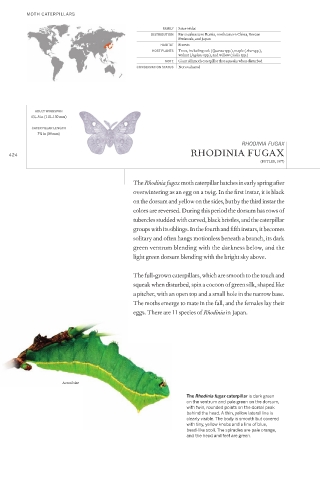
                                                             The Rhodinia fugax caterpillar is dark green
                                                             on the ventrum and pale green on the dorsum,
                                                             with twin, rounded points on the dorsal peak
                                                             behind the head. A thin, yellow lateral line is
                                                             clearly visible. The body is smooth but covered
                                                             with tiny, yellow knobs and a line of blue,
                                                             bead-like scoli. The spiracles are pale orange,
                                                             and the head and feet are green.

