


Page 418 - The Book of Caterpillars: A Life-Size Guide to Six Hundred Species From Around the World
P. 418
MOTH CATERPILLARS

                                                     FAMILY  Saturnidae
                                                 DISTRIBUTION  Mexico, south through Central America (Guatemala, Honduras,
                                                          Nicaragua, Costa Rica, and Panama)
                                                    HABITAT  Dry and rain forests at mid elevations of 4,000–5,000 ft
                                                          (1,220–1,525 m)
                                                  HOST PLANTS  Oak (Quercus oleoides)
                                                      NOTE  Silkmoth caterpillar found in the crowns of Central
                                                          American oaks
                                             CONSERVATION STATUS  Not evaluated


            ADULT WINGSPAN
           3⅛–4¼ in (80–110 mm)
           CATERPILLAR LENGTH
           3½–3¾ in (90–95 mm)
                                                                            OTHORENE VERANA
                                                          OTHORENE VERANA
    416
                                                                                     SCHAUS, 1900


                                            Othorene verana caterpillars hatch from large, pale green eggs,
                                            laid by the female silkmoth about a week earlier. The larvae
                                            consume a vast quantity of host plant leaves,  rst instars eating

                                            from the leaf edges while later instars devour entire leaves. The
                                            caterpillars are generally solitary and grow rapidly, developing
                                            through  ve instars and reaching maturity in about four weeks.

                                            Mature larvae raise the anterior portion of their body when
                                            resting. Pupation takes place underground, and there appear to
                                            be at least two generations annually in most of the species’ range.


                                            Females lay their eggs in the  rst few hours after sunset. Like the

                                            males, they have short lives, as adult Othorene verana silkmoths
                                            do not feed. There are only four species in the genus Othorene,
                                            all large silkmoths living in Central America. Othorene verana
                                            caterpillars appear to live exclusively in the crowns of their host
                                            trees in mid-elevation dry forests.


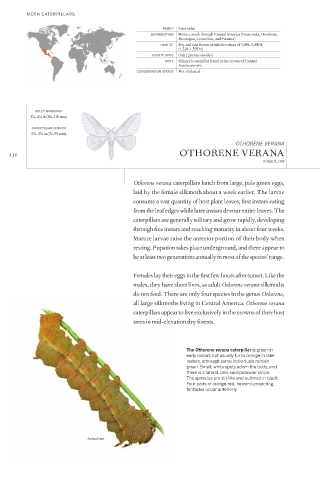
                                                             The Othorene verana caterpillar is green in
                                                             early instars but usually turns orange in later
                                                             instars, although some individuals remain
                                                             green. Small, white spots adorn the body, and
                                                             there is a lateral, pale subspiracular stripe.
                                                             The spiracles are slit-like and outlined in black.
                                                             Four pairs of orange-red, forward-projecting
                                                             tentacles occur anteriorly.


                             Actual size

