


Page 420 - The Book of Caterpillars: A Life-Size Guide to Six Hundred Species From Around the World
P. 420
MOTH CATERPILLARS

                                                     FAMILY  Saturniidae
                                                 DISTRIBUTION  Mexico, south to Brazil and Bolivia
                                                    HABITAT  Dry to humid tropical forests and savannahs
                                                  HOST PLANTS  Various trees, including oak (Quercus spp.), beech (Fagus spp.),
                                                          hawthorn (Crataegus spp), plum (Prunus spp.), palm
                                                          (Elaeis spp.), and Acacia spp.
                                                      NOTE  Stinging caterpillar of moth that ecloses smelling like
                                                          rotting onions
                                             CONSERVATION STATUS  Not evaluated


            ADULT WINGSPAN
           3¾–4⅝ in (95–120 mm)
           CATERPILLAR LENGTH
           2¾–4 in (70–100 mm)
                                                                             PERIPHOBA HIRCIA
                                                            PERIPHOBA HIRCIA
    418
                                                                                    (CRAMER, 1775)


                                            Periphoba hircia caterpillars hatch from about 200 ovoid eggs
                                            laid by the female moth in straight-line pairs along host plant
                                            leaves. Hatching occurs around two to three weeks after
                                            ovipositing, depending on temperature. Early instar caterpillars
                                            are gregarious and processionary, feeding and resting in groups.
                                            By the fourth instar, caterpillars disperse and feed singly at night,
                                            resting by day. There are six instars, the larvae taking about
                                            53 days to reach the pupal stage. After wandering for a day,
                                            full-fed caterpillars form a cocoon on the ground under debris.


                                            The spines of this caterpillar can cause a painful sting lasting

                                            for a number of hours. Newly emerged adult moths give o  a
                                            pervading and persistent odor of rotting onions. Females use
                                            pheromones to call males for mating, and both sexes live for
                                            less than a week. Occasionally, Periphoba hircia larvae cause
                                            economic damage to oil palm plantations.


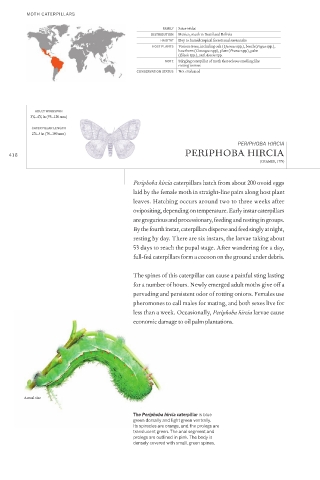
         Actual size

                                            The Periphoba hircia caterpillar is blue
                                            green dorsally and light green ventrally.
                                            Its spiracles are orange, and the prolegs are
                                            translucent green. The anal segment and
                                            prolegs are outlined in pink. The body is
                                            densely covered with small, green spines.

