


Page 424 - The Book of Caterpillars: A Life-Size Guide to Six Hundred Species From Around the World
P. 424
MOTH CATERPILLARS

                                                     FAMILY  Saturniidae
                                                 DISTRIBUTION  Most of Africa south of the Sahara and west of Ethiopia
                                                          and Somalia
                                                    HABITAT  Tropical forests and savannahs
                                                  HOST PLANTS  Many, including Zebrawood (Brachystegia speciformis) and
                                                          Bauhinia spp.
                                                      NOTE  Large, cryptic caterpillar that has many natural enemies
                                             CONSERVATION STATUS  Not evaluated, but widespread


            ADULT WINGSPAN
           3½–4⅝ in (90–120 mm)
           CATERPILLAR LENGTH
             2¾ in (70 mm)
                                                                          PSEUDOBUNAEA IRIUS
                                                              POPLAR EMPEROR
    422
                                                                                   (FABRICIUS, 1793)


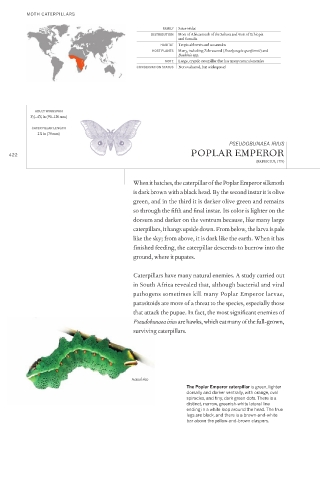
                                            When it hatches, the caterpillar of the Poplar Emperor silkmoth
                                            is dark brown with a black head. By the second instar it is olive
                                            green, and in the third it is darker olive green and remains
                                            so through the  fth and  nal instar. Its color is lighter on the


                                            dorsum and darker on the ventrum because, like many large
                                            caterpillars, it hangs upside down. From below, the larva is pale
                                            like the sky; from above, it is dark like the earth. When it has
                                            finished feeding, the caterpillar descends to burrow into the
                                            ground, where it pupates.


                                            Caterpillars have many natural enemies. A study carried out
                                            in South Africa revealed that, although bacterial and viral
                                            pathogens sometimes kill many Poplar Emperor larvae,
                                            parasitoids are more of a threat to the species, especially those

                                            that attack the pupae. In fact, the most signi cant enemies of
                                            Pseudobunaea irius are hawks, which eat many of the full-grown,
                                            surviving caterpillars.


                                           Actual size
                                                             The Poplar Emperor caterpillar is green, lighter
                                                             dorsally and darker ventrally, with orange, oval
                                                             spiracles, and tiny, dark green dots. There is a
                                                             distinct, narrow, greenish-white lateral line
                                                             ending in a white loop around the head. The true
                                                             legs are black, and there is a brown-and-white
                                                             bar above the yellow-and-brown claspers.

