


Page 425 - The Book of Caterpillars: A Life-Size Guide to Six Hundred Species From Around the World
P. 425
MOTH CATERPILLARS

                      FAMILY  Saturniidae
                  DISTRIBUTION  Northeastern South America, along the eastern slope of the
                           Andes, forming a crescent south to Bolivia and southeastern Brazil
                     HABITAT  Humid forests

                  HOST PLANTS  Unknown; has eaten many di erent plants in captivity

                      NOTE  Well-camou aged caterpillar that feeds at night
             CONSERVATION STATUS  Not evaluated


                                                                                   ADULT WINGSPAN
                                                                                 2⅝ –4¾ in (67–123 mm)
                                                                                  CATERPILLAR LENGTH
                                                                                    3⅛ in (80 mm)
            PSEUDODIRPHIA AGIS
            PSEUDODIRPHIA AGIS                                                                   423

            (CRAMER, 1775)


            When it hatches from its white egg, the Pseudodirphia agis
            caterpillar is reddish brown with black spines. It is processional
            and, at all times during its early stages, remains in a dense group,
            with members working their way toward the nibbled edge of a
            leaf, taking turns to feed. By the third instar, the caterpillar is
            mostly brownish black with green spines and varied pink and


            white patterns on its sides. In the  nal instar, it becomes  attened

            in pro le. When mature, the caterpillar of P. agis burrows into
            sphagnum moss or similar material and creates a silk-lined
            chamber for pupation.


            Pseudodirphia agis is among 39 currently listed species of
            its genus, which belongs to the subfamily of Hemileucinae
            silkmoths. Caterpillars of this genus are urticating, and all feed

            at night and cluster parallel on a tree branch by day,  attened

            and well camou aged. Pseudodirphia species are found from
            southeastern Mexico to Argentina, and many are difficult
            to tell apart.


                                                                         Actual size
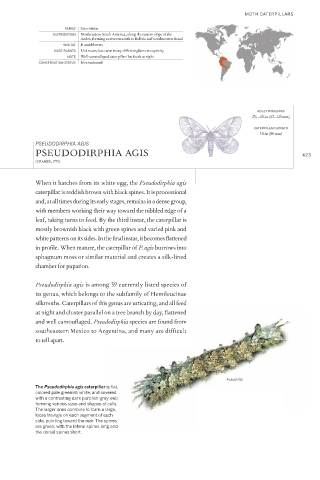
            The Pseudodirphia agis caterpillar is   at,
            colored pale greenish white, and covered
            with a contrasting dark purplish-gray web
            forming various sizes and shapes of cells.
            The larger ones combine to form a large,
            loose triangle on each segment of each
            side, pointing toward the rear. The spines
            are green, with the lateral spines long and
            the dorsal spines short.

