


Page 421 - The Book of Caterpillars: A Life-Size Guide to Six Hundred Species From Around the World
P. 421
MOTH CATERPILLARS

                      FAMILY  Saturniidae
                  DISTRIBUTION  Parts of Italy and Austria, across the Balkans to the Caucasus,
                           Turkey, Israel, and Lebanon
                     HABITAT  Dry, open deciduous woodlands
                  HOST PLANTS  Mostly oak (Quercus spp.), but occasionally poplar (Populus spp.)
                           and other deciduous trees
                      NOTE  Hairy caterpillar that changes from black to green
             CONSERVATION STATUS  Not evaluated


                                                                                   ADULT WINGSPAN
                                                                                  2 ⁄  –3 ⁄   in (62–88 mm)
                                                                                  CATERPILLAR LENGTH
                                                                                    2⅜ in (60 mm)
            PERISOMENA CAECIGENA
            AUTUMN EMPEROR                                                                       419

            (KUPIDO, 1825)


            The female Autumn Emperor moth lays creamy-brown eggs on
            twigs in rows of up to six, with as many as 100 laid in total. The
            eggs overwinter, and the caterpillars hatch the following spring
            when the weather grows warmer. The larvae are gregarious at

             rst, lying together on the upper surface of leaves and feeding
            on young leaves and the male catkins, but then move apart when
            they are older to become solitary. They pupate on the ground,
            where they spin a dark brown, double-walled cocoon among the
            leaf litter, spending the hot, dry summer as a pupa and emerging
            in fall as the weather cools.


            The large, night- ying Autumn Emperors are, as their name

            suggests, on the wing in fall, from September to November.
            The males become active at dusk, while the females  y later

            in the evening. The moths are short-lived, surviving just a few
            days. Most mate on the first night, with the females rapidly
            laying all their eggs soon after.


                                                                                           Actual size

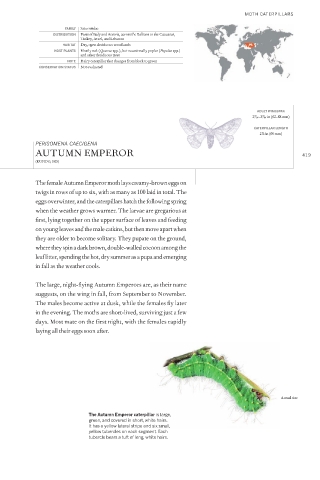
                             The Autumn Emperor caterpillar is large,
                             green, and covered in short, white hairs.
                             It has a yellow lateral stripe and six small,
                             yellow tubercles on each segment. Each
                             tubercle bears a tuft of long, white hairs.

