


Page 429 - The Book of Caterpillars: A Life-Size Guide to Six Hundred Species From Around the World
P. 429
MOTH CATERPILLARS

                      FAMILY  Saturniidae
                  DISTRIBUTION  United States (southeastern Texas), south to southern Peru
                     HABITAT  Lower altitude tropical forests
                  HOST PLANTS  Wide variety, including ash (Fraxinus spp.), willow (Salix spp.),
                           and Citrus spp.
                      NOTE  Giant silkmoth whose cocoons were once used as rattles
             CONSERVATION STATUS  Not evaluated, but considered secure


                                                                                   ADULT WINGSPAN
                                                                                 4⅛–4⅝ in (105–120 mm)
                                                                                  CATERPILLAR LENGTH
                                                                                    3½ in (90 mm)
            ROTHSCHILDIA LEBEAU
            ROTHSCHILDIA LEBEAU                                                                  427

            (GUÉRIN-MÉNEVILLE, 1868)


            The Rothschildia lebeau caterpillar hatches from among a group
            of white eggs and immediately eats the remaining eggshell.
            Black with yellow spots at this stage, it groups together with its
            siblings as they feed at the leaf edge. As the caterpillar grows
            and molts through  ve instars, its colors change each time, and


            it moves away from its group. After about  ve weeks it expels
            its gut contents and spins a teardrop-shaped, hard, silvery
            cocoon suspended by a stem of multiple threads fastened to
            a tree branch.

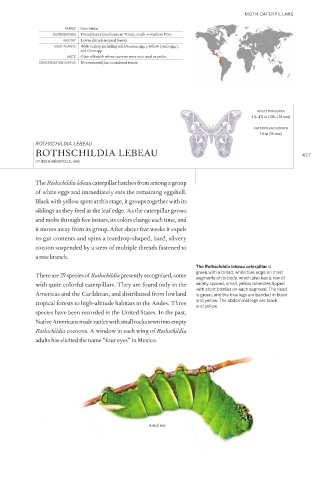
                                                                The Rothschildia lebeau caterpillar is
            There are 29 species of Rothschildia presently recognized, some   green with a broad, white fore edge on most
                                                                segments of its body, which also has a row of
            with quite colorful caterpillars. They are found only in the   widely spaced, small, yellow tubercles tipped
            Americas and the Caribbean, and distributed from lowland   with short bristles on each segment. The head
                                                                is green, and the true legs are banded in black
            tropical forests to high-altitude habitats in the Andes. Three   and yellow. The abdominal legs are black
                                                                and yellow.
            species have been recorded in the United States. In the past,
            Native Americans made rattles with small rocks sewn into empty
            Rothschildia cocoons. A window in each wing of Rothschildia
            adults has elicited the name “four eyes” in Mexico.


                                                Actual size

