


Page 428 - The Book of Caterpillars: A Life-Size Guide to Six Hundred Species From Around the World
P. 428
MOTH CATERPILLARS

                                                     FAMILY  Saturniidae
                                                 DISTRIBUTION  Southeastern Mexico, south to Bolivia, and the Caribbean (Saint
                                                          Lucia and Martinique)
                                                    HABITAT  Tropical forests and scrub
                                                  HOST PLANTS  Cercidium microphillum; in captivity has fed on plum and wild
                                                          cherry (Prunus spp.)
                                                      NOTE  Silkmoth caterpillar that is unusually colorful
                                             CONSERVATION STATUS  Not evaluated


            ADULT WINGSPAN
           3¾–4⅝ in (95–120 mm)
           CATERPILLAR LENGTH
             3⅛ in (80 mm)
                                                                         ROTHSCHILDIA ERYCINA
                                                   ROTHSCHILDIA ERYCINA
    426
                                                                                     (SHAW, 1796)


                                            When the Rothschildia erycina caterpillar hatches from its
                                            brownish egg, it is black and yellow and usually among a dozen
                                            or more siblings. One by one the larvae make their way to where

                                            the  rst one to hatch has chosen to rest on the underside of an
                                            appropriate leaf. As they grow and molt, they change colors and
                                            detail in each of their  ve instars,  nally becoming independent


                                            and displaying a broad pattern of white, black, green, and bright
                                            orange. This is aposematic coloration, warning birds that a
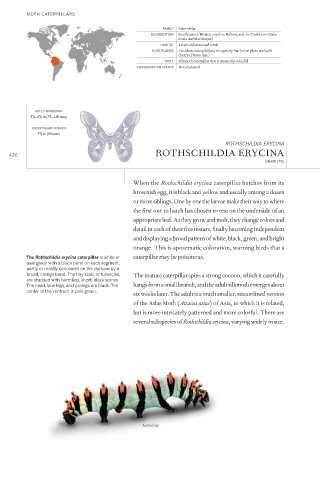
         The Rothschildia erycina caterpillar is white or   caterpillar may be poisonous.
         pale green with a black band on each segment,
         partly or mostly concealed on the dorsum by a
         broad, orange band. The tiny scoli, or tubercles,   The mature caterpillar spins a strong cocoon, which it carefully
         are studded with harmless, short, black spines.
         The head, true legs, and prolegs are black. The   hangs from a small branch, and the adult silkmoth emerges about
         center of the ventrum is pale green.  six weeks later. The adult is a much smaller, streamlined version
                                            of the Atlas Moth (Attacus atlas) of Asia, to which it is related,
                                            but is more intricately patterned and more colorful. There are
                                            several subspecies of Rothschildia erycina, varying widely in size.


                                              Actual size

