


Page 430 - The Book of Caterpillars: A Life-Size Guide to Six Hundred Species From Around the World
P. 430
MOTH CATERPILLARS

                                                     FAMILY  Saturniidae
                                                 DISTRIBUTION  China and Korea, but naturalized in Japan and other areas across
                                                          Asia, Europe, North and South America, Africa, and Australia
                                                    HABITAT  Lowland forests in China, and in parks and gardens in areas
                                                          where naturalized
                                                  HOST PLANTS  Tree of heaven (Ailanthus altissima) and various shrubs
                                                      NOTE  Distinctive, silk-producing caterpillar found in many
                                                          urban areas
                                             CONSERVATION STATUS  Not evaluated


            ADULT WINGSPAN
          4⅛–5½ in (105–140 mm)
           CATERPILLAR LENGTH
           2¾–3 in (70–75 mm)
                                                                               SAMIA CYNTHIA
                                                      AILANTHUS SILKMOTH
    428
                                                                                     (DRURY, 1773)


                                            The Ailanthus Silkmoth caterpillar—used to produce wild
                                            silk—hatches from pale eggs laid in crescent-shaped rows of
                                            10 to 20 on leaves up to 20 days earlier. The young caterpillars
                                            are yellow with black-tipped tubercles, becoming pale green

                                            with age. They are gregarious at  rst but move apart in the latter
                                            stages, becoming solitary. The caterpillar spins a grayish cocoon
                                            attached to the petiole of a leaf on the host plant.


                                            Ailanthus Silkmoths  y in early summer and, in some parts of
                                            their range, there may be a second generation in late summer.
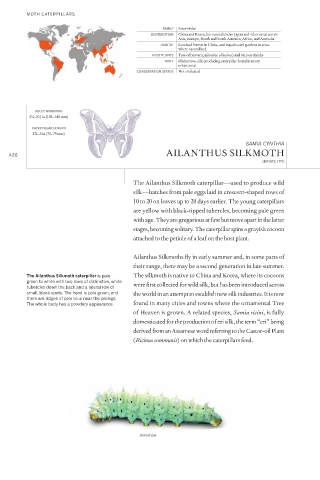
          The Ailanthus Silkmoth caterpillar is pale   The silkmoth is native to China and Korea, where its cocoons
          green to white with two rows of distinctive, white   were  rst collected for wild silk, but has been introduced across

          tubercles down the back and a lateral row of
          small, black spots. The head is pale green, and   the world in an attempt to establish new silk industries. It is now
          there are ridges of pale blue near the prolegs.
          The whole body has a powdery appearance.   found in many cities and towns where the ornamental Tree
                                            of Heaven is grown. A related species, Samia ricini, is fully
                                            domesticated for the production of eri silk, the term “eri” being
                                            derived from an Assamese word referring to the Castor-oil Plant
                                            (Ricinus communis) on which the caterpillars feed.


                                              Actual size

