


Page 431 - The Book of Caterpillars: A Life-Size Guide to Six Hundred Species From Around the World
P. 431
MOTH CATERPILLARS

                      FAMILY  Saturniidae
                  DISTRIBUTION  Europe, and across northern Asia to Russian Far East
                           and northern China

                     HABITAT  Moorlands, heathlands, open scrub,  eld margins,
                           and woodland edges
                  HOST PLANTS  Various, including birch (Betula spp.), willow (Salix spp.),
                           Heather (Calluna vulgaris), and bramble (Rubus spp.)
                      NOTE  Bright green caterpillar that basks in the sun
             CONSERVATION STATUS  Not evaluated


                                                                                   ADULT WINGSPAN
                                                                                  1     –2⅜ in (40–60 mm)
                                                                                  CATERPILLAR LENGTH
                                                                                  Up to 2⅜ in (60 mm)
            SATURNIA PAVONIA
            EMPEROR MOTH                                                                         429

            (LINNAEUS, 1758)


            Emperor Moth caterpillars hatch from eggs laid in batches
            10 to 14 days earlier on the stems of a variety of host plants.
            The young larvae, which consume part of their eggshell before
            congregating together, are hairy and black but become green
            with age. Initially, they are gregarious but disperse when older.
            When disturbed, the caterpillars release a bitter  uid that deters

            predators, such as birds, parasitic  ies, and ants. They crawl into

            thick vegetation to pupate.

            The pupae overwinter in pear-shaped cocoons, varying in color
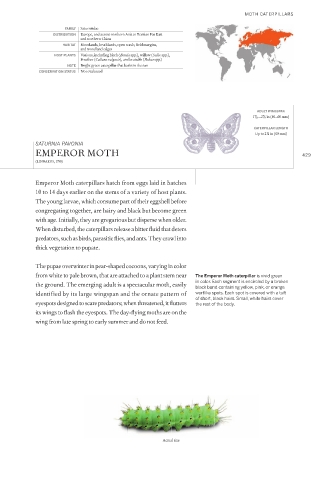
            from white to pale brown, that are attached to a plant stem near   The Emperor Moth caterpillar is vivid green
            the ground. The emerging adult is a spectacular moth, easily   in color. Each segment is encircled by a broken
                                                               black band containing yellow, pink, or orange
            identified by its large wingspan and the ornate pattern of   wartlike spots. Each spot is covered with a tuft

            eyespots designed to scare predators; when threatened, it  utters   of short, black hairs. Small, white hairs cover
                                                               the rest of the body.
            its wings to  ash the eyespots. The day- ying moths are on the


            wing from late spring to early summer and do not feed.


                                                     Actual size

